52 stories
·
0 followers

Pluralistic: Voting is to politics as shopping is to boycotts (01 Oct 2026)

1 Share


Today's links


Two suffragists in period dress, ceremonially putting ballots into a ballot box. The background has been replaced with an elaborate collage of 19th C printing-press parts. The ballots are glowing with radiant spikes. The face of the ballot box has been replaced with an Nvidia Vera Lynn GPU.

Voting is to politics as shopping is to boycotts (permalink)

Here's a funny thing about the right to vote: it wasn't won by voting.

From the Magna Carta to the US Constitution to the Emancipation Proclamation to 19th Amendment, voting rights (what you might call "Big P" Politics) were always downstream of protests, riots, petitions, mass movements, strikes and good, old fashioned community organizing (that is, "small p" politics).

Which is to say, Big P politics matter, but to make them matter, we need a lot of small p politics. That means that democracy isn't something you do every couple of years with a ballot paper (though that's an important aspect of the process). Democracy is continuous.

If you've ever wondered why your vote seems to accomplish so little, I think you can blame the near-abolition of small p politics by Big P politicians of every stripe. Indeed, Obama's genius was summoning up an army of door-knocking, phone-banking small p political activists and then euthanizing that organization after he won the election:

https://newrepublic.com/article/140245/obamas-lost-army-inside-fall-grassroots-machine

For Obama, the grassroots were useful for one thing: getting out the vote. The last thing he wanted was for millions of activated voters to turn into activists who'd flame him and harangue him and picket him if they didn't like his compromises. Boy, did Obama ever compromise.

He let the bank executives who created the Great Financial Crisis off the hook and encouraged them to foreclose on the homes of millions of Americans, the very same public that had bailed them out:

https://theweek.com/articles/624777/obamas-biggest-failure

He shielded the CIA's torturers from scrutiny and prosecution:

https://journals.law.harvard.edu/ilj/2009/04/obama-publishes-torture-memos-immunizes-cia-staff/

He reneged on his promise to shut down Gitmo:

https://www.pbs.org/newshour/show/obama-failed-close-guantanamo

And his promise to hold the phone companies to account for their complicity in the NSA's mass domestic surveillance:

https://www.pbs.org/wgbh/frontline/article/obama-on-mass-government-surveillance-then-and-now/

He stepped up secret drone warfare:

https://www.cfr.org/articles/obamas-final-drone-strike-data

And unconstitutional domestic surveillance:

https://www.eff.org/deeplinks/2017/01/obama-expands-surveillance-powers-his-way-out

Whenever I raise this, Obama's apologists come out of the woodwork to tell me that "the president isn't the Green Lantern," and that Obama couldn't act without help from Congress and the Senate, who wouldn't back his plays.

I think that Trump's presidency has shown us how much power the president really has even when the legislature won't play ball. But even if you accept the Green Lantern apologetics, the fact remains that Obama could have had a clamoring army of ardent supporters in the streets, defending his agenda against recalcitrants in his own party and wreckers in the GOP. He chose not to have that army. He sent that army home.

It's like Obama heard the story about post-election FDR telling civil rights leaders, "I want to do it, now make me do it," and concluded, "I don't want to do it, so I'd better not let anyone make me do it":

https://www.quora.com/Did-Franklin-Roosevelt-ever-say-I-agree-with-you-I-want-to-do-it-now-make-me-do-it

Of course, Trump is doing everything he can to extinguish both small p politics and Big P Politics. It's not just his wildly illegal voter suppression tactics. He's banning and prosecuting political groups, invoking anti-terror laws (which Obama supported and promised would only be used proportionately and wisely) to chase his grassroots opposition underground:

https://www.whitehouse.gov/presidential-actions/2025/09/designating-antifa-as-a-domestic-terrorist-organization/

Liberals are often contemptuous of grassroots movements (cf "basket of deplorables," "Green Lantern" scolding), but the right is terrified of them. The right's political leadership is terrified of its own grassroots, and rightly so, because those people are maniacs, and they're the reason the GOP has been pushed into its most extreme positions. The right's grassroots, meanwhile, are afraid of the left's grassroots. The last thing they want is a militant, organized, mobilized base pushing Dem politicians to take the stands that are wildly and widely popular in America, from Medicare for All to an end to ICE – the Mamdani agenda, in other words.

Mamdani is the anti-Obama. He shows what happens when a progressive candidate nurtures and co-governs with their base after the election, using millions of passionate, committed, everyday people to steamroller anyone who gets in the way of his agenda:

https://www.nyc.gov/content/100days/pages/

Of course the downside of this is that when Mamdani reneges on his pledges, he is loudly and furiously held to account for it:

https://www.thecityreporter.nyc/2026/02/19/mamdani-budget-parks-libraries/

Mamdani understood that he would be corralled into compromises if he won the mayoralty and that when he made those compromises, his base would come after him with the unmistakable fury of betrayed idealists. He also understood that any comfort he enjoyed by sidelining his base while in office would come at a price far higher than being yelled at by his supporters: it would cost him the ability to get anything done.

Voting for Mamdani was important. It got him elected. But staying organized – in unions, neighborhood clubs, affinity groups, DSA chapters and mutual aid groups – is what's letting him get stuff done, and stopping him from bailing on his promises as politically infeasible.

In other words, voting only matters if it's the final stage of a sustained campaign to build and mobilize popular power. Without that, voting will get you precious little. The right's leadership understands this very well, which is why they've spent years attacking unions, community organizers like Acorn, and activist institutions like Planned Parenthood. We must defend voting rights – Big P Politics – to the bitter end, but we need to defend organizing – small p politics – just as ferociously.

The reduction of politics to voting is part of the 50 year neoliberal project whose foremost goal is to make you think of yourself as an atomized individual and not as a member of a polity. Turning "politics" into "voting" is absolutely in line with Margaret Thatcher's dictum that "there is no such thing as society." It's the same move that convinced workers that the answer to bad working conditions is looking your boss in the eye and threatening to change jobs (not forming a union and striking).

It's also the same move that transformed "boycotts" into "shopping." Boycotts are a collective enterprise. Before a boycott takes place, small-p political groups hold meetings, organize alternatives and communicate their demands. During a boycott, organizers work to insulate participants from reprisals, like the Montgomery Bus Boycott organizers who reasoned and remonstrated with employers who disciplined workers whose participation made them late for work.

And yes, as part of a boycott, you make some consumption choices. You buy X instead of Y. But "shopping" by itself isn't a boycott. You can't "vote with your wallet" (especially not when billionaires get to vote against you with their wallets):

https://pluralistic.net/2025/09/13/consumption-choices/#marginal-benefits

Shopping isn't politics, and while voting is Politics (Big P), it's also not politics (small p). A boycott, on the other hand, is politics. What's more, "shopping" has the same relationship to "boycotts" that "voting" has to "politics." It's a step you take, after you've laid a lot of groundwork with other people, as part of a mass movement.

I understand why shopping and voting are more attractive than boycotts and politics. Meetings suck. Hell is other people:

https://locusmag.com/feature/commentary-cory-doctorow-hell-is-other-people/

But changing the system requires systemic work. Hell is other people because other people are great but it's so hard to get them to do things your way. That takes time and understanding and togetherness and arguing and forgiving.

Not everyone has time or capacity for that, and at any given time, we don't all have to be doing that work. We can take turns, spelling each other off at times in our lives when we have more or less slack. But lots of us have to be in the fight, or all of us will get screwed. There aren't enough of us doing politics right now. We can tell, because our politicians are so contemptuous of the grassroots that they will sell us out without a moment's hesitation, smugly certain that they will face no consequences for doing so:

https://pluralistic.net/2026/09/22/happy-chudmas/#baloney-in-our-slacks

Oligarchs have it easy. Where we have to convince people to fight, they can pay or threaten people to bring them into line. But oligarchs' power is wearing thin. The data-center uprising shows how much fury there is out there, looking for a productive outlet:

https://www.bloodinthemachine.com/p/with-the-backlash-to-data-centers

Data centers are very bad and very visible, so they make for good targets. But data centers are only the physical extrusion of a vast, brutal, extractive system. The most important way to fight data centers is to take everyone you meet protesting one and organize with them to scare the shit out of "your" politicians so they don't dare compromise on anything.


Hey look at this (permalink)


A shelf of leatherbound history books with a gilt-stamped series title, 'The World's Famous Events.'

Object permanence (permalink)

#25yrsago GWB's press secretary to media: "watch what you do, watch what you say" https://web.archive.org/web/20010926223602/https://www.whitehouse.gov/news/releases/2001/09/20010926-5.html#BillMaher-Comments#BillMaher-Comments

#20yrsago Stencils kit “may not be reproduced in any form” https://web.archive.org/web/20061022000842/http://www.fairuseday.com/index.php/2006/10/01/copyright-is-broken/

#20yrsago DVD Jon selling Apple DRM to Apple’s competitors https://web.archive.org/web/20061004191106/https://featured.gigaom.com/2006/10/02/dvd-jon-fairplays-apple/

#20yrsago Unpaid diplomatic parking tickets as index of national corruption https://web.archive.org/web/20130719065306/https://www.theatlantic.com/magazine/archive/2006/10/primary-sources/305203/

#20yrsago Canadian deported to Syria for torture is cleared https://www.theguardian.com/world/2006/oct/02/worlddispatch

#20yrsago Gilberto Gil slams WIPO https://fromgeneva.blogspot.com/2006/09/wipo-general-assembly-impressions-from.html

#20yrsago Speech given by censored Apple WiFi hacker at ToorCon https://craphound.com/cache_toorcon_2006.txt

#10yrsago Company suspected of blame in Office of Personnel Management breach will help run new clearance agency https://www.reuters.com/article/us-usa-security-background-idUSKCN1202M6/

#10yrsago Wells Fargo started demanding fraud of its employees in 1998; Illinois cuts Wells off from state business https://www.citizen.org/wp-content/uploads/wells-fargo-king-of-cross-sell.pdf

#10yrsago Google: if you support Amazon’s Echo, you’re cut off from Google Home and Chromecast https://variety.com/2016/digital/news/google-home-amazon-echo-chromecast-1201874125/

#5yrsago How the IMF loan-sharks the global south https://pluralistic.net/2021/10/02/debt-trap/#global-arm-breakers

#1yrago Decarbonization at a distance https://pluralistic.net/2025/10/02/there-goes-the-sun/#carbon-shifting


Upcoming appearances (permalink)

A photo of me onstage, giving a speech, pounding the podium.
https://www.epl.ca/blogs/post/elbows-up-with-cory-doctorow/


A screenshot of me at my desk, doing a livecast.

Recent appearances (permalink)


A grid of my books with Will Stahle covers..

Latest books (permalink)


A cardboard book box with the Macmillan logo.

Upcoming books (permalink)

  • "The Post-American Internet," a geopolitical sequel of sorts to Enshittification, Farrar, Straus and Giroux, 2027

  • "Unauthorized Bread": a middle-grades graphic novel adapted from my novella about refugees, toasters and DRM, FirstSecond, April 20, 2027

  • "Enshittification, Why Everything Suddenly Got Worse and What to Do About It" (the graphic novel), Firstsecond, 2027

  • "The Memex Method," Farrar, Straus, Giroux, 2027


Colophon (permalink)

Today's top sources:

Currently writing:

  • “Once Is Enemy Action,” a science fiction novel about the origins of modern technofascism. Today's words: 509 (20770 total).

  • "The Post-American Internet," a sequel to "Enshittification," about the better world the rest of us get to have now that Trump has torched America. Fourth draft completed. Submitted to editor.

  • A Little Brother short story about DIY insulin PLANNING


This work – excluding any serialized fiction – is licensed under a Creative Commons Attribution 4.0 license. That means you can use it any way you like, including commercially, provided that you attribute it to me, Cory Doctorow, and include a link to pluralistic.net.

https://creativecommons.org/licenses/by/4.0/

Quotations and images are not included in this license; they are included either under a limitation or exception to copyright, or on the basis of a separate license. Please exercise caution.


How to get Pluralistic:

Blog (no ads, tracking, or data-collection):

Pluralistic.net

Newsletter (no ads, tracking, or data-collection):

https://pluralistic.net/plura-list

Mastodon (no ads, tracking, or data-collection):

https://mamot.fr/@pluralistic

Bluesky (no ads, possible tracking and data-collection):

https://bsky.app/profile/doctorow.pluralistic.net

Medium (no ads, paywalled):

https://doctorow.medium.com/

Tumblr (mass-scale, unrestricted, third-party surveillance and advertising):

https://mostlysignssomeportents.tumblr.com/tagged/pluralistic

"When life gives you SARS, you make sarsaparilla" -Joey "Accordion Guy" DeVilla

READ CAREFULLY: By reading this, you agree, on behalf of your employer, to release me from all obligations and waivers arising from any and all NON-NEGOTIATED agreements, licenses, terms-of-service, shrinkwrap, clickwrap, browsewrap, confidentiality, non-disclosure, non-compete and acceptable use policies ("BOGUS AGREEMENTS") that I have entered into with your employer, its partners, licensors, agents and assigns, in perpetuity, without prejudice to my ongoing rights and privileges. You further represent that you have the authority to release me from any BOGUS AGREEMENTS on behalf of your employer.

ISSN: 3066-764X

Read the whole story
hoz
1 hour ago
reply
Share this story
Delete

The Rahm Bomb

1 Share

Friends,

I’m spending all my time and efforts on the upcoming midterms (as many of you are) urging Dems to speak out for average working people, for lower prices and higher wages, and against the big-money corruption that’s the core of today’s Republican Party.

But I’ve also got to speak out about one Democrat who’s not running for midterm office but is using the midterms to build his base among future Democratic office-holders for his 2028 presidential run.

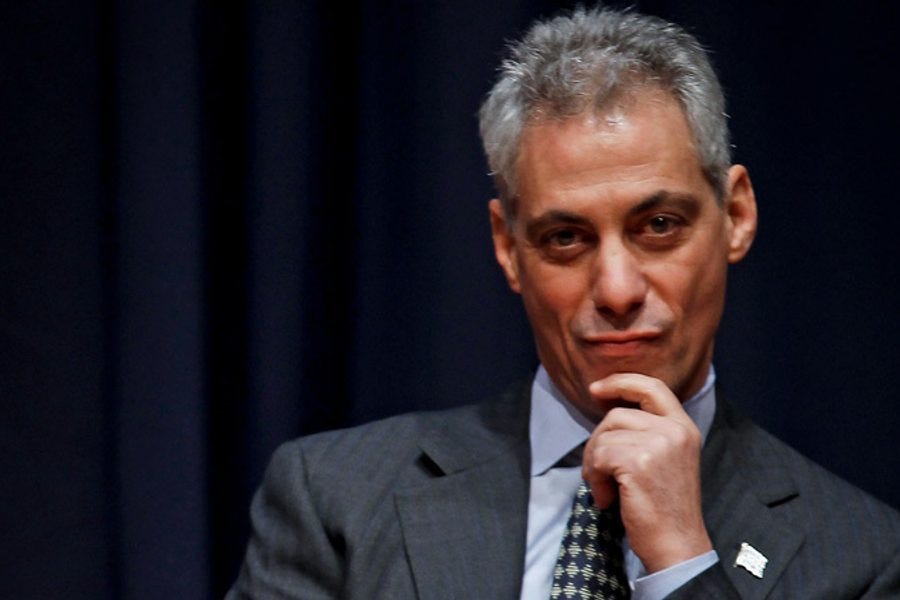
Today’s New York Times carried a Page 1 puff piece about him titled “Rahm Emanuel Makes His 2026 Play” with the subhead “The longtime Democratic insider has emerged as a behind-the-scenes force in his party’s push to win back Congress. After that, he’ll think about 2028.”

I know Emanuel. I worked with him for years in the Clinton administration, and then when he was Obama’s chief of staff.

Rahm Emanuel represents everything that’s been wrong about the Democratic Party for the last 34 years — its dependence on money from big corporations and the wealthy, its reluctance to embrace bold ideas to reverse widening inequalities, and its indifference to the needs of average working people — and Democratic candidates should be warned off him.

Chris Lehmann’s piece from The Nation magazine confirms my own experience with Emanuel:

***

A specter is haunting the 2028 Democratic presidential field: the specter of reactionary centrism, which sports the political brand name of Rahm Emanuel.

Emanuel, the former Clinton White House policy enforcer who went on to become chief of staff in the Obama administration and mayor of Chicago, is going through all the motions of an early presidential hopeful.

He’s completed a “spin-free” bike tour through New Hampshire, he’s staged a photo-op on an Omaha “beer picket line,” and he’s delivered a high-profile speech arguing that America needs to adopt a more aggressive posture toward Benjamin Netanyahu’s irredentist warfare regime in Israel (without, of course, affirming anything close to the legitimate political agency of Palestinians). He’s making the rounds on the very serious interview and conference circuits to tout his broader foreign-policy sagesse.

Through it all, Emanuel has burnished his credentials as a wised-up disciplinarian figure in a Democratic Party that’s poised to succumb to a wild-eyed left-wing agenda that will poison its standing among independent-minded Real Americans during a pivotal election cycle.

There’s a singular irony in Emanuel’s peddling this prescription in 2026, ahead of an all-but-confirmed 2028 presidential run: It’s the same hoary consultant-brewed panacea that he introduced as one of the initial class of New Democrats in the early 1990s.

For this same structural critique to hold more than three decades later, you have to bracket the history of three centrist Democratic administrations, together with the disastrous legacies on trade, labor, financial regulation, and brain-dead austerity they left the MAGA movement to exploit at will.

You have to somehow accept the idea that a Democratic establishment dominated by big-money donors, tech lobbyists, and their leased consultant mouthpieces has fallen victim to a sans-culotte insurgency led by left-wing congressional staffers and “the groups” of the nonprofit sector, while the forgotten Middle America scours the political landscape in vain for a voice to represent it.

You also, not incidentally, have to disregard most of the actual political career of one Rahm Emanuel.

It’s no exaggeration to say, with apologies to Hegel’s characterization of Napoleon at the Battle of Jena, that Emanuel has embodied the neoliberal world-spirit on horseback. Back then, Emanuel’s policy portfolio was largely taken up with the push to win congressional approval for NAFTA and the 1994 crime bill—a measure that symbolized the savvy New Democratic repudiation of the old liberal interest-group model of lawmaking.

After weathering right-wing assaults on liberal governance as a prolonged study in crime coddling and kowtowing to union bosses, the Clintonian Capitol Hill strategists led by Emanuel were declaring their independence from the ancien régime by embracing traditional right-wing policy initiatives and placing a modest it-takes-a-village rhetorical spin on them.

By the squalid and inert later phase of the Clinton policy agenda—when the administration signaled total moral capitulation to the Gingrich right by signing its welfare-eradication legislation into law—it was no surprise to see Emanuel leading the charge in the White House.

Emanuel also sought, unsuccessfully, to turn Clinton into a hard-line immigration hawk, urging the president to “claim and achieve record deportations of criminal aliens.”

You could say that Emanuel was simply playing to his base: He became a key player in the Clinton White House after leading the big-donor fundraising initiative of the 1992 Clinton campaign. Emanuel’s long-mythologized DC reputation as a blunt, loud, and profane interlocutor stems from this time, when he could be heard berating big-ticket prospects with come-ons like “Five thousand dollars is an insult! You’re a twenty-five-thousand-dollar person!”

This marks the other sprawling paradox of Emanuel’s career: In posturing as the advocate of commonsense pragmatic governing, he is always representing a boardroom-first vision of politics.

Prior to his election to Congress in 2022, Emanuel spent a lucrative tour as an investment banker, bringing in a cool $16 million payday over three years. (He was, in fact, one of three former investment bankers to serve as chief of staff in Obama’s hope-and-change administration.)

What he has rhetorically packaged as a savvy, problem-solving approach to lawmaking based on bipartisan outreach has always been the drearily consistent wish list of capital, from his effort as mayor to kneecap the Chicago Teachers’ Union to an accompanying wave of school closures and privatization to a bloated private-equity plan to take over the city’s parking operations to a disastrous accord with Elon Musk’s Boring Company to create a transit tunnel.

When a pair of reporters from the Chicago Reader filed a FOIA request to access the mayor’s meeting schedule—which had been mostly shielded from public view—they found that he met almost exclusively with donors, and almost never with actual community leaders.

In other words, if you want an advance vision of a Democratic politics shorn of the influence of “the groups” and other irksome activists, look no further than Emanuel’s plutocratic governing record in Chicago. Alternately, you can divine the waning influence of groups-style activism in the very fact that Emanuel is now bruited as a serious candidate for the Democratic presidential nomination at all.

The scandal that paralyzed, and effectively ended, his mayoralty in Chicago was his administration’s obscene cover-up of the police murder of 17-year-old Lacquan McDonald, a Black man shot 16 times in the back by the police as he was walking away. When the video of McDonald’s killing was released, 64 percent of Chicagoans disputed Emanuel’s claim that he had never seen it before; more than half agreed that he should resign office immediately.

It says everything about the priorities of establishment Democrats that Emanuel should be an early 2028 contender, just six years after Senator Amy Klobuchar was effectively forced to scuttle her future presidential prospects in the wake of George Floyd’s police murder, since she had previously served as a county prosecutor in Minneapolis.

Grim as Emanuel’s litany of policy calls is, it may not represent his most woeful legacy in Democratic politics. That distinction likely falls to his 2006 tour as head of the Democratic Congressional Campaign Committee. During that pivotal midterm cycle, Emanuel largely prevailed in a feud over the “50-state strategy” advocated by Democratic National Committee chairman Howard Dean.

Dean argued that for the Democrats to secure a long-term governing coalition they had to mount viable candidates in—and devote resources to—states and districts that presented as redoubts of deeper-red Republicanism. The idea was akin to bolstering a flailing major-league team’s farm system with prospects that would yield significant dividends over the long haul, in lieu of a more myopic “win now” strategy focused on immediate returns.

In his accustomed role as gatekeeper to the large-donor caste, Emanuel carried the day, using his campaign coffers to effectively cut loose Democratic candidates in districts that would be a stretch to win in that cycle, and lavishing money on his preferred brand of donor-friendly campaign hopeful: right-leaning difference trimmers who often had a military résumé, some of them former Republicans. Even in that historic Democratic wave election, Emanuel’s handpicked standard-bearers fared poorly—but, far more consequently, Democrats relinquished viable candidacies in formerly contested states and districts for the political generation ahead.

A 2013 study from Governing magazine found that Dean’s project—which wasn’t officially mothballed until the end of his DNC tenure in 2009—yielded striking results. In 20 deep-red states, Democrats gained three House seats, and 39 state legislative ones, while clocking an increase in presidential vote share between 2004 and 2008 in 15 of the 20 states. … One could go further still, and note that as Democrats retreated to safer, donor-anointed battlegrounds to leave greater stretches of the political map in play for the right, ruthless GOP electioneers pounced.

The follow-on midterm cycle witnessed the devastating assault that the right termed Operation REDMAP—a bald effort to gerrymander as many congressional seats for Republican candidates as possible coming out of the 2010 Census.

In other words, as Democrats, high on their own donor-driven presidential-cycle savvy, believed they were cleverly targeting winnable districts in lieu of expanding the electoral map, Republicans seized control of the map, and every individual vote they could get their hands on.

Emanuel’s latest ploy for elite Beltway attention is an interview with Politico correspondent Jonathan Martin. It bears all the hallmarks of brain-dead access journalism, from a hackneyed introduction by Martin flogging all the clichés of Emanuel’s foulmouthed rise to power to Emanuel’s own farcical efforts to depict himself as a lone misunderstood apostle of financial regulation in the Obama White House and a heroic advocate of improved educational performance. (Tell it to the Chicago Teachers Union, pal.)

But its chief selling point—yet again—is Emanuel’s wised-up counsel to Democrats who dare to believe in a world where they might be allowed nice things. “I’m not very excited by people that took an election that was focused on Donald Trump’s corruption and now focused on a party that has candidates that want to defund the police, decriminalize the criminal justice system, and want to run an open border policy,” he maunders, before circling for good measure into some performative bigotry: “I’m tired of discussions about bathroom access, and I want to start having discussions about classroom excellence.”

The good news here is that the feeling is very much mutual. As Bernie Sanders declared on Face The Nation when host Margaret Brennan presented him with Emanuel’s latest screed against “the Bernie bros” in The Wall Street Journal: “People are sick and tired of the Rahm Emanuels and Democratic establishment and Republican establishment…. The American people are tired of a rigged economy, a corrupt campaign finance system. They want real change. They don’t want Rahm Emanuel and the establishment maintaining the status quo.”

Amen. Politico opportunistically titled Martin’s interview “Rahm Emanuel on Why the Democrats Keep on Losing.” The subhead should have simply explained that the short answer is Rahm Emanuel.

Share

Read the whole story
hoz
4 days ago
reply
Share this story
Delete

10 Steps To Fix What Trump Has Broken

1 Share

Friends,

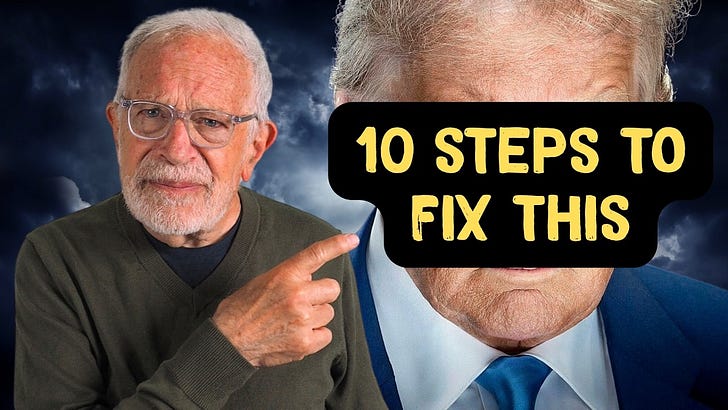
If we want to clean up the mayhem Trump and his regime have created — and prevent anything like this from happening again — here are the 10 big reforms every political candidate should support.

They’re structural reforms in how our political system works, rather than policies such as Medicare for All, affordable housing, childcare, or a $20 minimum wage. But these structural reforms are necessary prerequisites to getting good policies enacted. They must be passed by Congress in order for anything else to get done.

I’m summarizing them below the video. Please watch and share:

Here are the 10 necessary structural reforms:

1: Enact Supreme Court term limits. Limit justices to 18-year terms, after which they return to lower federal courts.

2: Crack down on conflicts of interest. Apply federal conflict-of-interest laws to the president and vice president, ban all elected officials (and Cabinet members) from trading individual shares of stock, and require their financial holdings be put in a blind trust.

3: Stop political interference in criminal prosecutions. Prohibit presidents from influencing Justice Department prosecutions and require congressional review of pardons and commutations.

4: End the gerrymandering wars. Require all states to create independent commissions that draw congressional district maps.

5. Restore the Voting Rights Act. Reinstate protections against racially discriminatory voting maps and restore federal oversight of states with a history of voter discrimination.

6. Protect the freedom of the press. Prevent media monopolies by stopping large corporations and major media owners from buying up more news outlets.

7: Eliminate political litmus tests for federal funding. Hold the president in contempt for impounding funds appropriated by Congress. This includes funding for academic and scientific research, which should be free from political influence.

8. Tax extreme wealth. Enact a wealth tax on multimillionaires and billionaires and end the stepped-up basis loophole that allows huge fortunes to be inherited without having to pay taxes on capital gains.

9. Elect presidents by the popular vote. Replace the Electoral College through a constitutional amendment or a compact among states to award their electoral votes to the national popular vote winner.

10. Get big money out of politics. Expand public financing to match small-dollar campaign donations and pass a constitutional amendment to overturn the Citizens United decision.

Trump has revealed how easily our system can be abused. But opposing him isn’t enough. We need lasting structural reforms that make it harder for anyone — president, speaker of the House, Supreme Court justice, or other officials — to abuse their power in the future.

Please send this list to any candidate you’d like to win on November 3.

Share


Read the whole story
hoz
7 days ago
reply
Share this story
Delete

Blood test for multiple cancers clears crucial hurdle on track to FDA approval

1 Share

If approved, the test could help catch cancers early—but more research is still needed, experts say

Read the whole story
hoz
8 days ago
reply
Share this story
Delete

This week’s Joseph N. Welch Award goes to …

1 Share

The Honorable Indira Talwani

Friends,

By now we’ve almost taken for granted that federal district court judges will probably stop — or at least pause — the worst of Trump’s authoritarian moves. We owe them a huge debt of gratitude.

Case in point: U.S. District Judge Indira Talwani, who on August 27 effectively stopped Trump’s plan to use the U.S. Postal Service to restrict mail-in voting.

In issuing a temporary restraining order blocking its enforcement, Judge Talwani used the standard two criteria for such a judicial pause: that (1) the plaintiffs are likely to succeed on their claims when the case goes to trial, and (2) they face irreparable harm in the meantime if the order is implemented.

Judge Talwani found that plaintiffs — a group of blue states and voting rights groups — were likely to succeed in their claims that Trump’s and the U.S. Postal Service’s plan is unconstitutional because it interferes with states’ authority to administer their own elections and risks disenfranchising eligible voters, and that the Postal Service lacks authority to do it. Furthermore, she found an “overwhelming risk” to Americans who need access to mail ballots to vote, and that if the plan were implemented, they wouldn’t be able to.

Her temporary restraining order blocked enforcement of the plan in the 23 states that had sued to stop it. The Trump regime immediately appealed her ruling. Days later, the U.S. Court of Appeals for the First Circuit affirmed her order, rejecting the Trump regime’s appeal.

Trump has now gone to the Supreme Court, which has not as yet issued a final decision. For now, the Postal Service is expected to handle election mail as usual. North Carolina and parts of Wisconsin have already started sending out absentee ballots for the general election.

Let me pause here for a moment to praise Judge Talwani for her principled courage. Like many district court judges who have stopped Trump, she’s undoubtedly received a great deal of criticism — some possibly in the form of violent threats — but has not received the public honor she deserves.

Talwani’s decision in this case is an example of what’s been happening across the nation, especially over the last dreadful 19 months.

The sequence has been this: (1) Trump issues a patently unconstitutional order, (2) attorneys general of blue states and various other groups go to a district court seeking to pause it until there’s a full trial on the issue, (3) a district court judge issues a temporary restraining order that pauses Trump’s, (4) Trump’s Justice Department appeals the pause, (5) an appellate court more often than not agrees with the district court judge, and (6) the Justice Department then seeks Supreme Court review.

The regime has mounted efforts in nearly all 50 states to obtain their complete voter rolls containing sensitive information about registered voters in their states, with the Justice Department arguing that the information is needed to ensure states have programs in place for maintaining accurate voter rolls.

Most have declined to provide complete lists. In response, the Justice Department has filed lawsuits against 30 states and the District of Columbia in an effort to force them to hand over the voter data.

But district court judges across the nation have held the line. (Some of these judges were appointed by Trump.) So far, the Department of Justice has lost all 23 trial-level and initial decisions. It’s an astounding record. The DOJ has appealed most of them.

This sounds like a cold-blooded process, but every step entails human beings making ethical decisions about what to do next.

Many of us have become inured to the cowardice and complicity of the people inside the regime who are acting without regard to the ethical consequences of what they’re doing — people such as those advising Trump about whether and how to draft his unconstitutional executive orders, lawyers in the Justice Department willing to defend these orders and appeal decisions that pause or stop them, and officials in other departments and agencies, such as the United States Postal Service, willing to implement them.

And most of us have become so accustomed to the courage and conviction of people outside the regime who are trying to stop these unconstitutional orders — especially district court and appellate judges — that we no longer recognize their heroism.

I’m making Judge Talwani recipient of this week’s Joseph N. Welch Award, which I give to people who — like Welch, when he confronted Senator Joseph McCarthy in 1954 — stand up to authoritarian bullies who threaten our freedoms, and who thereby protect us all.

The award really goes to all district court judges who have been holding the line against Trump. These judges deserve the appreciation of all Americans — just as those who have enabled and collaborated with the regime deserve our condemnation.

All of these people are making moral choices, whether or not they recognize them as such. Democracy is a moral choice.

Share

Read the whole story
hoz
16 days ago
reply
Share this story
Delete

President AOC?

1 Share

Friends,

One litmus test for me of potential presidential candidates in 2028 is how many people ask me if a particular person has a chance of winning. I doubt they’d ask unless they supported that person. So when lots of people start asking about someone, I begin to take that person seriously.

Over the past month, the person who’s jumped to the head of the line in these sorts of questions is Rep. Alexandria Ocasio-Cortez. Most of the people who ask me about her are under 30, and they’re hugely enthusiastic about her.

Before I give you my response, let me say something about the person in American politics she’s most associated with — Bernie Sanders — and the organization she’s most identified with — the Democratic Socialists of America.

Bernie

I’ll say it straight out: I love Bernie. For years now, he’s been leading all of us into the future. He’s given progressives a clear direction.

I love his authenticity. Some people like Trump because he says whatever he wants, but he’s an asshole. Bernie’s authenticity comes from saying what he wants and speaking the truth. Although Bernie is blunt, when he growls “this grotesque level of income and wealth inequality is immoral,” he means it. And he’s right.

I love his chutzpah. Bernie once announced that Starbucks’s anti-labor CEO Howard Schultz had agreed to testify before the Senate Committee on Health, Education, Labor and Pensions, which Bernie chaired, because he had threatened him with a subpoena if he didn’t. The National Labor Relations Board had filed more than 80 complaints against Starbucks for refusing to negotiate in good faith with its workers in more than 280 of their stores that voted to unionize. “I look forward to hearing from Mr. Schultz as to when he intends to end his illegal anti-union activities and begin signing fair first contracts with the unions,” Bernie said.

I love him because he sounds like a vintage record (even his voice has the crackle of worn vinyl).

I love Bernie because he has endless patience for important things and no patience for unimportant conversation. In 2010, he delivered an eight-and-a-half-hour speech on the Senate floor to protest the extension of tax cuts instituted during George W. Bush’s presidency. I was in the Capitol at the time and dropped by his office to congratulate him on his marathon. He quickly thanked me, then waved me off to take a phone call.

Just before the California Democratic primary in 2020, he gave a stem-winder of a speech in Oakland. We had a late dinner at a small dive on Shattuck Avenue that was empty except for the two of us, until a supporter spied us through the window and came bounding in with a Bernie poster.

“Senator, would you sign my …?”

“Not now! We’re eating!” Bernie barked.

In all my years in and around politics, I’d never come across a candidate willing to do this.

I love Bernie because he’s a true populist, a word that has gotten a terrible rap since Trump arrived on the scene but should be redeemed. It means for the people and against the powerful. Trump pretends to be a populist, but he’s always wanted to be one of the powerful since he entered politics and been in their pockets.

I love Bernie because he has almost single-handedly changed the national conversation, turning proposals that had once been on the Democratic fringe into respectable and, in some cases, mainstream Democratic positions: creating jobs by rebuilding the nation’s infrastructure; providing free tuition at public universities; breaking up the big banks; guaranteeing workers paid medical and family leave.

I love Bernie because even in his 80s his indignation hasn’t faded, nor has his energy.

When he entered Congress in 1991 as an independent, he wasn’t particularly well liked. That may have had something to do with his telling the press that Congress “is not working. It is failing. Change is not going to take place until many hundreds of these people are thrown out of their offices” and charging that “Congress does not have the courage to stand up to the powerful interests. I have the freedom to speak my mind.” Congressman Barney Frank shot back: “Bernie alienates his natural allies. His holier-than-thou attitude — saying, in a very loud voice, he is smarter than everyone else and purer than everyone else — really undercuts his effectiveness.” Joe Moakley, another Massachusetts Democrat, then chairman of the powerful House Rules Committee, complained that Bernie “screams and hollers, but he is all alone.”

Bernie’s lack of popularity on Capitol Hill didn’t hold him back. He was reelected to the House seven times and was one of the founding members and the first chair of the Congressional Progressive Caucus, which has grown steadily from six members in 1991 to 97, as of this writing.

His ascent to the Senate in 2006 was astonishing — beating the Republican candidate, Richard Tarrant, one of the wealthiest men in Vermont, by 33 percentage points.

I backed Bernie in 2016 when he ran for the Democratic nomination for president against Hillary Clinton and backed him again in 2020. I took some crap for doing this from Clinton people, but I’m glad I did it. The system needed shaking up. It needed Bernie’s candidacy even if he wasn’t going to get the nomination.

In the 2016 Democratic primaries and then again in 2020, young people all over America wore buttons reading “Feel the Bern.” They were like the young admirers of Ruth Bader Ginsburg, another warrior who combined progressive conviction with elder crankiness.

I love Bernie because he has more guts than any politician I know. Hell, he has more guts than just about anyone I know.

As far as I’m concerned, AOC couldn’t find a better role model than Bernie, and Bernie couldn’t find a better mentee than AOC.

Democratic Socialism

Which brings me to the organization AOC is most identified with, the Democratic Socialists of America.

Soon after Bernie began running for the 2016 Democratic presidential nomination, his campaign manager warned me he was about make a speech to “introduce” the public to democratic socialism. I was impressed that he had the guts to do this but worried about his timing. “Does he have to do it now?” I asked. The campaign manager told me Bernie was committed to doing it and couldn’t be persuaded otherwise. It was pure Bernie.

Ever since Franklin D. Roosevelt pushed for Social Security, Republicans have used “socialism” to scare Americans away from doing anything big that we need done.

They still are. On Wednesday, Trump and a shameful parade of Republican members of Congress up for reelection excoriated Democrats for being “soft” on “communism” and “socialism.”

Last week, the House adopted a Republican-backed resolution (introduced by Colorado Republican Rep. Jeff Crank) that condemns socialism in all its forms and explicitly names the Democratic Socialists of America. (The vote passed 220–192. Eight so-called “moderate” Democrats broke ranks to vote with Republicans.)

But America is changing. A Cato Institute poll showed that 53 percent of Gen Z have a positive view of socialism, while 45 percent view capitalism positively.

I’ve taught a large number of students who call themselves socialists, but they do so mainly because they reject capitalism — its monopolies, its treatment of workers, its disregard of human rights, its raging inequalities.

Most don’t have a clear idea of what socialism means, other than more money spent on social services, safety nets, and public investment in schools, healthcare, and the poor — and higher taxes on the wealthy to pay for all of this.

Over the past year, the youth and student branch of the national Democratic Socialists of America has seen a massive surge in membership, growing by more than 50 percent and starting more than 50 new chapters. The organization claims it now has more than 3,000 members across 160 chapters, the most in its 50-year history. But compared to the American electorate — even voters under 30 — that’s still very tiny.

DSA’s growth reflects a growing national spotlight on the organization after a string of Democratic primary wins for candidates who align with the group, from New York to Colorado.

And it follows a tense year of campus organizing by pro-Palestinian students pushing their schools to divest from Israel amid its war with Hamas over Gaza, which had been the entry point for many college students into the DSA.

The focus of young people in the DSA has centered on divestment from Israel. But that’s not all. They’re also engaged in student worker labor organizing and pushing for “sanctuary campuses,” which involves both blocking ICE from college campuses and pushing schools to end corporate sponsorships that benefit ICE.

Just as JD Vance has wide support in Turning Point USA, the conservative group founded by the late Charlie Kirk, AOC has wide support in the growing ranks of the Young DSA.

AOC

So what do I tell the growing number of people — especially young people — who ask me about AOC’s presidential chances? I tell them the truth, as I see it.

She’s an extraordinarily gifted leader. She’s also an enormously powerful communicator (I don’t know any politician more skillful on social media). I admire her progressive views and values.

I doubt the nation is ready to elect a woman in 2028, especially after Kamala Harris lost to Trump in 2024 and Hillary Clinton lost to him in 2016. But it will be ready at some point, and I hope that point comes soon.

AOC is only 36 years old (37 in October). She has plenty of time. She also has nothing to lose and much to gain by trying for the nomination in 2028. It would give her even more of a national platform and hugely valuable exposure to and experience with voters in states that she doesn’t know well.

And if she doesn’t win the nomination for president, she can always run against Chuck Schumer to become senator from New York.

Share

Read the whole story
hoz
20 days ago
reply
Share this story
Delete
Next Page of Stories