19 stories
·
0 followers

Who's the Biggest Money Behind the Throne?

1 Share

Friends,

It’s important that we demonstrated against Trump’s assertion of royal powers.

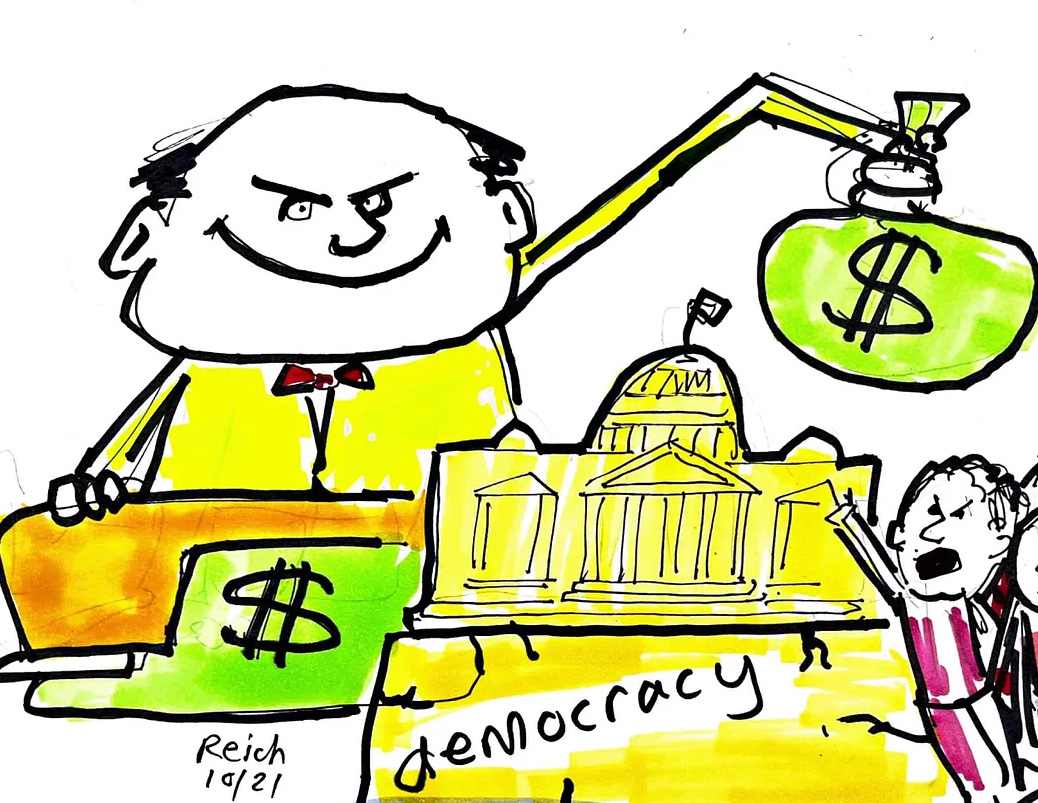
It’s at least as important to follow the money — and learn the identities of America’s billionaire royalty who crowned Trump in the first place. They’re now spending another regal fortune to keep Congress under his control.

Today I’m going to name names.

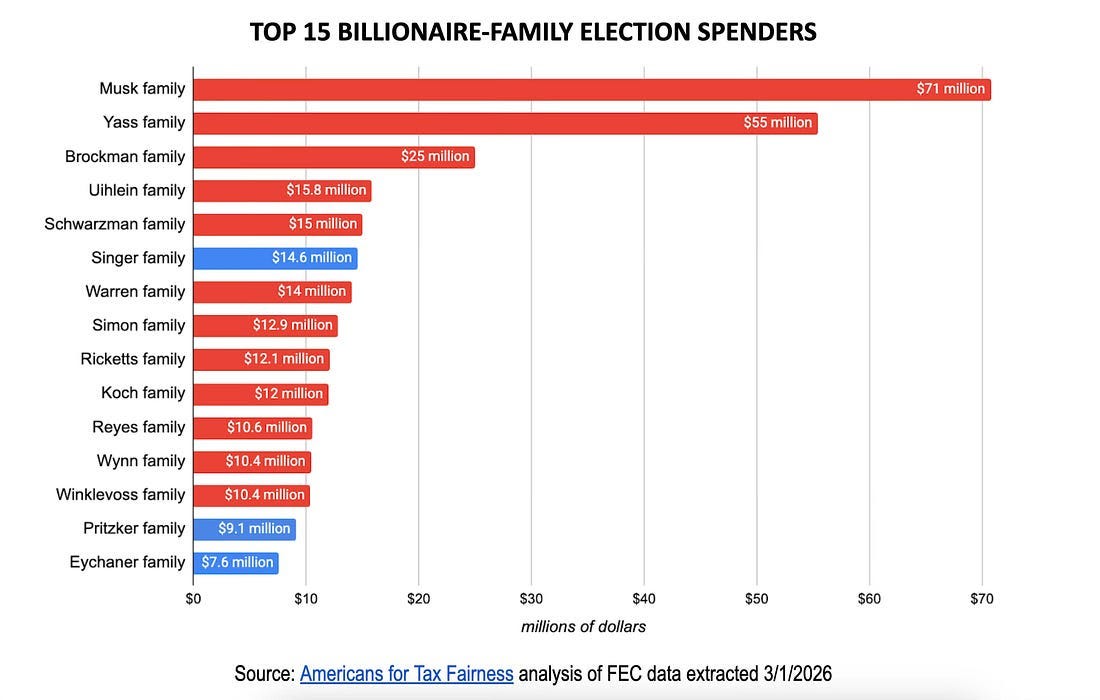
As of March 1, according to a new report from Americans for Tax Fairness, the 50 biggest-spending billionaires in American politics had already contributed over $433 million to the upcoming midterm political campaigns.

Not surprisingly, 80 percent of this haul is in support of Republican candidates or conservative issue groups.

Given how early we are in the process, and how contributions tend to accelerate closer to Election Day, 2026 will almost surely set a new record for billionaire money in midterm elections. (Because of our current pathetically weak campaign finance laws, courtesy of the Supreme Court, fat-cat contributors are funneling huge sums through super PACs. While such spending is supposed to be independent of the campaign being supported, rules against coordination are now going largely unenforced.)

WHO THEY ARE

MUSK
The single biggest contributor is, of course, Elon Musk — the world’s richest person — who has plunked down almost $71 million into Republican midterm campaigns so far.

Musk contributed a total of $278 million in the 2024 election cycle, mostly for getting Trump reelected. His “investment” has paid off nicely. Musk’s net worth has grown 220 percent since Trump won in 2024.

Musk’s latest cash infusion to Republicans came after his short destructive stint as head of the “Department of Government Efficiency,” where he helped place his cronies into high-level positions throughout the federal government.

Yes, I know. Musk and Trump had a falling out. But since then both have realized they have more to gain as political partners. And now that Musk’s SpaceX satellite system is integral to Pete Hegseth’s Department of “War,” Musk has filed for an initial public offering, seeking a valuation over $2 trillion and potentially raising $75 billion, which would make it the largest IPO in history.

The New York Times reports that Musk participated in a phone call on Tuesday with Trump and Prime Minister Narendra Modi of India. Musk’s companies have taken on significant investment from sovereign wealth funds from Middle Eastern countries, including Saudi Arabia and Qatar, and he has long coveted a greater commercial presence in India.

YASS
Musk is followed in the billionaire-spending-on-politics sweepstakes by Wall Street financier Jeff Yass, who has contributed more than $55 million so far in this midterm election cycle. He’s donated $16 million to MAGA, Inc., Trump’s super PAC, dedicated to supporting candidates he backs.

The Yass donations came as Trump was deciding whether to delay the forced sale of the social media app TikTok, in which Yass was a major investor. Trump repeatedly delayed the sale, saving Yass’s lucrative investment.

In addition, Yass has donated $10 million apiece to the anti-tax Club for Growth PAC; to another PAC that wants to drain funds from public schools to support private ones; and to a PAC that supports the political ambitions of former Republican presidential candidate Vivek Ramaswamy. Yass has also donated $7.5 million to a PAC dedicated to supporting House members of (and House candidates aspiring to belong to) the radical-right Freedom Caucus.

BROCKMAN
In third place is San Francisco AI tech mogul Greg Brockman, who has given $25 million in midterm money so far — mostly to Trump’s super PAC, presumably because Brockman wants to dismantle state-level AI regulations through federal preemptive action and thinks Trump will help him.

As president of OpenAI, Brockman recently agreed to let the Pentagon use his company’s AI technology — which his competitor Anthropic publicly refused to do over concerns about mass surveillance and autonomous weapons.

UIHLEIN
Packaging titan Dick Uihlein has long been a major donor to right-wing candidates and causes. (Among the beneficiaries of his largesse have been many politicians who denied Donald Trump’s loss to Joe Biden in the 2020 presidential election.)

The biggest recipients of Uihlein midterm money so far are two super PACs for which Uihlein and his wife are the principal backers: $5 million to Restoration of America, supporting conservative political candidates; and $3.5 million to Fair Courts America, which the Uihleins founded to support conservative candidates for judicial office.

SCHWARZMAN
Private equity mogul Stephen Schwarzman has long been a major Republican Party megadonor. As CEO of the giant investment management company Blackstone, Schwarzman has built a career on predatory business practices and disregard for the public good, while leveraging his immense wealth to rig the system in his favor.

So far in the midterms, Schwarzman has spent: $5 million for Trump’s super PAC; $5 million for the Republican Senate Leadership Fund; $1 million for the Republican Congressional Leadership Fund; and $1 million to a super PAC exclusively backing Republican Senate Whip John Cornyn.

***

As we approach the 250th anniversary of our independence from the British monarchy, it’s more important than ever to commit ourselves to getting big money out of American politics.

As I’ve noted, here’s a potential way to do this without waiting for the Supreme Court to reverse its Citizens United decision or amending the Constitution. Another is through small-donor financing. The two aren’t mutually exclusive; indeed, we should push for both.

Billionaires are not singularly responsible for corrupting our system of government, of course — and not all billionaires are doing this.

But as wealth continues to concentrate at the top, America finds itself in a doom loop in which giant campaign donations from the super-rich buy political decisions that make them even richer.

This doom loop is the power behind the throne on which Trump shits sits.

Share

Read the whole story
hoz
20 hours ago
reply
Share this story
Delete

If You Need a Laptop, Buy It Now

1 Share

Recently, a Costco in Florida instituted a new store policy. An employee told me that he was asked to open up every desktop computer displayed in the electronics section and remove the memory chips. Otherwise, the RAM harvesters would get them. Elsewhere, criminal groups are misdirecting trucks carrying RAM in order to loot them. All of this is happening because of a generational shortage of a part used in practically every electronic gadget on Earth.

RAM is your device’s short-term memory—storing the information it needs to handle any active tasks. (RAM stands for “random-access memory.”) To put this in intimately familiar terms, it is what your computer runs out of when you have too many browser tabs open. And right now, the price of RAM is skyrocketing. From September to February, the price of a single 64GB stick of RAM went from roughly $250 to more than $1,000.

Gamers who build their own juiced computers were among the first to notice that something was off. Starting in the fall, it became so difficult for them to acquire memory sticks that they have given a name to this crisis: RAMageddon. Now it’s quickly becoming everyone’s problem. In December, Dell jacked the prices of some of its computers by hundreds of dollars because of what its COO has referred to as “this memory crisis, shortage, whatever you want to call it.” Earlier this month, for the same reason, Lenovo raised prices on some of its products, including the popular ThinkPad.

This seems to be only the beginning. Matteo Rinaldi, the head of a global semiconductor-research institute run by Northeastern University, told me he recently asked a colleague what new laptop he should buy. “He told me right away, ‘Well, you know, it almost doesn’t matter which one,’” Rinaldi said. “‘Just decide you want to buy now, because prices are going up.’”

RAM is suddenly so expensive because memory is powering the AI boom. Data centers require huge amounts to run the models that underlie AI tools such as ChatGPT and Claude—especially as they become capable of handling more complicated tasks. This year, a group of tech giants—Amazon, Alphabet, Meta, Microsoft, and Oracle—is set to collectively spend half a trillion dollars on the AI build-out. Roughly a third of that money is being spent on memory alone, according to Dylan Patel, the founder of SemiAnalysis, a popular semiconductor-research firm.

[Read: Welcome to a multidimensional economic disaster]

The insatiable demand has “cannibalized our conventional consumer-electronics supply,” Yang Wang, an analyst at Counterpoint Research, a market-research firm, told me. Every major RAM manufacturer has shifted production lines to service AI data centers. This year, 70 percent of memory-chip products made globally will be destined for them. In South Korea, where two of the biggest RAM manufacturers are based, Silicon Valley executives are reportedly booking hotels in the country’s tech districts, frantically hoping to secure inventory. A Korean newspaper has given them a name: RAM beggars.

Ideally, this problem would be solved by producing a whole lot more RAM. Micron, one of the biggest RAM manufacturers, is building a factory in New York that will cost more than any other private investment in the state’s history. Elon Musk recently suggested that Tesla will build its own RAM factories, called “fabs,” to ensure that he has enough memory to build robots and robotaxis. (“We’ve got two choices: Hit the chip wall, or make a fab,” he said in January.) But because of the complexity of making RAM, it could take even the richest man in the world two to five years to bring a new factory online. In the meantime, the world simply won’t have enough of a basic electronics part.

During RAMageddon, your gadgets will essentially be subject to an AI tax. It’s long been safe to assume that technology will get cheaper, faster, and better. But for the next few years, all signs suggest that devices will get more expensive, slower, and worse.

So far, it might not feel like all that much has changed. Earlier this month, Apple released its cheapest computer ever, the $599 Mac Neo. (It runs on a chip previously used only in iPhones.) But elsewhere, the price hikes have started. Samsung’s new Galaxy phones cost about $100 more than last year’s models, which the company’s COO has attributed in large part to the memory shortage. That’s despite the fact that Samsung is one of three companies in the world producing a significant amount of memory. Android phones have debuted this year with worse cameras, less storage, and slower processors than models released years ago, Wang told me, yet they still cost more.

Expect more changes like this. Gadget makers were able to initially swallow the cost of high RAM, but in the long run, they’ll have little choice but to pass on the cost to consumers. Consider Sony, which just announced that it will raise the price of the PlayStation 5 by $100. Before the adjustment, the memory chips inside a PS5 were worth more than the console itself. Smaller video-game manufacturers have pushed back launches or canceled the release of new consoles altogether.

To keep up with increasing RAM costs, things might get weird. Companies may jack up software prices to compensate for all the money they are sinking into memory chips. Sony’s CFO said on a recent earnings call that the company will survive the RAM crisis by “monetizing the installed base,” which seems to be a euphemism for finding ways to charge PlayStation owners more, or showing them more ads. (Sony did not respond to a request for comment.) At the same time, some companies may start to pare back products they’ve made “smart” to justify markups. Smart speakers, smart toilets, smart toasters, and smart deodorants (yes, really) all contain RAM. “Do we stop getting smart refrigerators? I don’t think that’s a net bad,” Laine Nooney, a technology historian at NYU, told me.

[Read: Your smart thermostat isn’t here to help you]

If that’s a silver lining, it’s not a particularly good one. TrendForce, a consumer-research firm, anticipates that laptop prices will rise by more than a third in the next few years. Computers under $500 will be extinct by 2028, according to a report from Gartner. Put differently, cheaper computers may fall off the map. “The $300 Chromebook and the $150 Android phone were products of a specific era—one where memory was cheap because nobody else was competing for it at this scale,” Nate Jones, an AI analyst, told me. “That era is ending.”

The consequences are global. All of this will be felt acutely in poor countries, where sub-$150 smartphones are especially popular. Some people may have no choice but to revert to flip phones, potentially cutting them off from essential apps and services. “You can’t build a gaming PC? Cool story, bro,” Wang, the smartphone analyst, said. “But then people in Africa can’t get a device which is crucial for their lives.”

So much money is going into the AI build-out that it is already reshaping the physical world. The data centers that are sprouting up across the United States are at least partly to blame for rising utility bills. And now people who may never have heard of Claude or asked ChatGPT for homework help will feel the effects of RAMaggedon. Hospitals have shelved plans to install touch screens that display medical charts and let patients order food, because the displays contain RAM, Rachael England, a manager at Vizient, a consulting firm that works with many U.S. hospitals, told me. Josh Bauman, the director of technology for a public-school district in Missouri, told me that if RAM prices keep increasing, his district may rethink buying a Chromebook for every student. For the foreseeable future, no one can escape the AI tax.

Read the whole story
hoz
3 days ago
reply
Share this story
Delete

Does red-light therapy work? What the research says

1 Share

People are buying helmets, face masks, vests and beds that emit long-wavelength light. Beneath the hype, there is some interesting biology.

Read the whole story
hoz
8 days ago
reply
Share this story
Delete

Treason in the Futures Markets

1 Share

A graph showing the price of a stock market

AI-generated content may be incorrect.

Source: Yahoo Finance

Over the weekend Donald Trump threatened dire vengeance on Iran unless its government opened the Strait of Hormuz within 48 hours, a deadline that would expire Monday evening in Washington. Specifically, he announced that the U.S. would begin bombing power plants — plants that supply electricity to Iran’s civilian population — unless the Strait was cleared.

But at 7:05 AM Monday Trump called the whole thing off — for five days, he said, but many people are assuming that the threatened action, which would have been a massive war crime, is now off the table.

The reason for the about-face, he claimed, was that the U.S. was engaged in productive negotiations with Iranian officials — although this seems to have come as news to the Iranians, who denied that any such negotiations are taking place. Sad to say, in this case, as I tried to explain yesterday, the fanatical, brutal Iranian regime is more credible than the president of the United States. Is he lying or living in a fantasy world? Neither possibility is comforting.

But in any case, Trump’s sudden climb-down was startling. Who could have seen this coming?

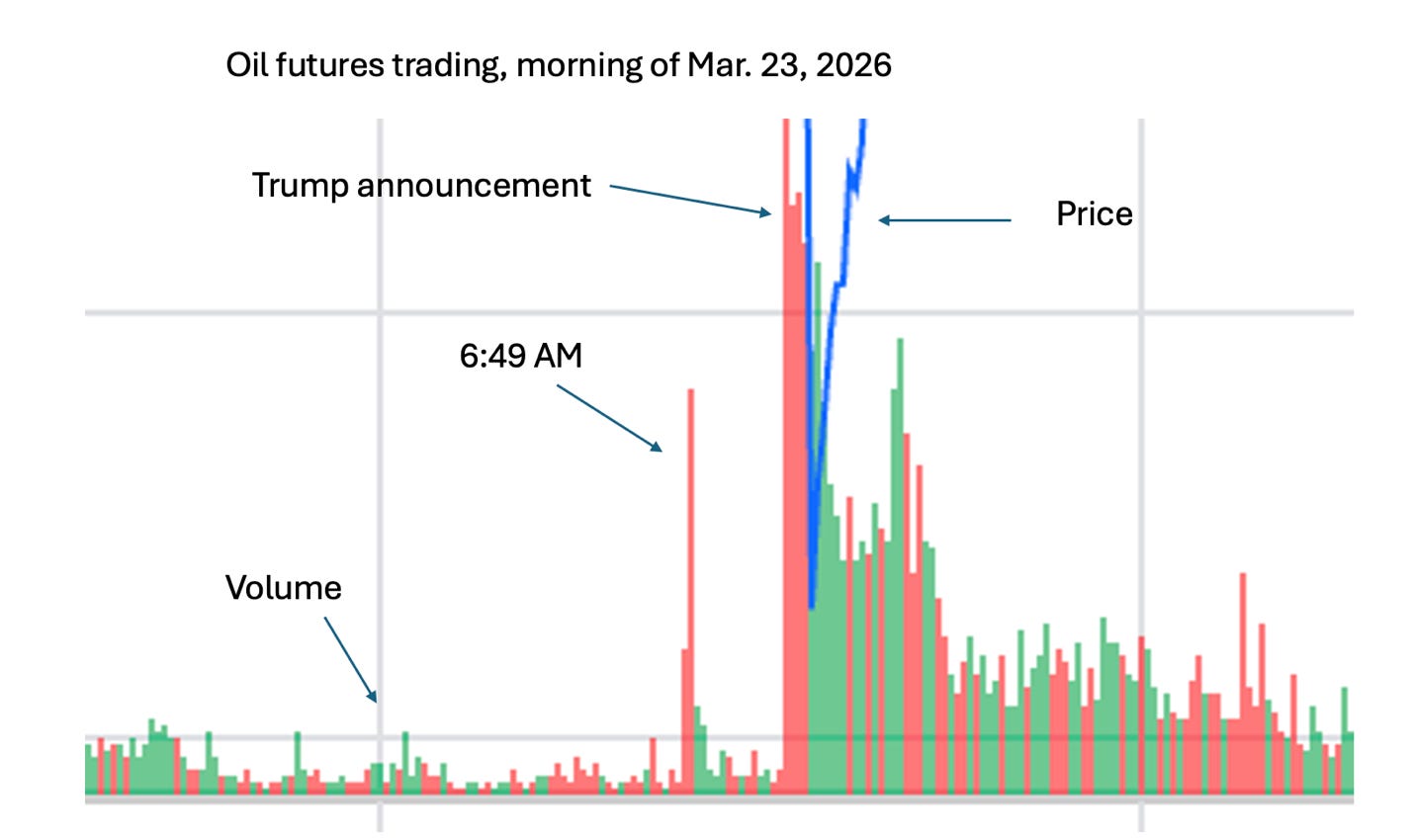
The answer is, the person or people who bought large quantities of stock market futures and sold large quantities of oil futures around 15 minutes before Trump’s announcement. As CNBC reports,

At around 6:50 a.m. in New York, S&P 500 e-Mini futures trading on the CME recorded a sharp and isolated jump in volume, breaking from an otherwise subdued premarket backdrop. With thin liquidity typical of early trading hours, the sudden burst stood out as one of the largest volume moments of the session up to that point.

A similar pattern was observed in oil markets. West Texas Intermediate May futures also saw a noticeable pickup in trading activity at roughly the same time, with a distinct volume spike interrupting otherwise quiet conditions.

This “sharp and isolated jump in volume” — which you can see for the oil futures market in the chart at the top of this post — was especially bizarre because there were no major news items — no major publicly available news items — to drive sudden big market transactions. The story would be baffling, except that there’s an obvious explanation: Somebody close to Trump knew what he was about to do, and exploited that inside information to make huge, instant profits.

This wasn’t the first time something like this has happened under Trump. There were large, suspicious moves in the prediction market Polymarket before previous attacks on Iran and Venezuela. But this front-running of U.S. policy was really large: the Financial Times estimates the sales of oil futures in that magic minute Monday morning at about $580 million, and that doesn’t count the purchases of stock futures.

When officers of a company or people close to them exploit confidential information for personal financial gain, that’s insider trading — which is illegal. But we have another word for situations in which people with access to confidential information regarding national security — such as plans to bomb or not to bomb another country — exploit that information for profit. That word is “treason.”

Why is profiting from insider information about national security decisions effectively a form of treason? First, it’s hard to think of a more fundamental principle for officials we entrust with important decisions, especially those that involve national security, that they or people they know should not be allowed to exploit their positions for personal gain.

Second, financial trading based on what should be closely held secrets reveals information to current or potential foreign adversaries. To exaggerate a bit, but only a bit, who needs to bribe agents within the government, or recruit them with honey traps, when you can infer the same information by keeping track of transactions on futures markets?

Finally, there isn’t that big a gap between using knowledge of national secrets to make lucrative financial trades and simply selling those secrets to the highest bidder. Once you’re breached the line that says you shouldn’t profit personally from access to information that is or should be highly classified, the line between trading based on state secrets and selling those secrets directly is a blurry one.

In fact, I’d very much like to know exactly who was making those trades yesterday morning. Were they people directly in the know, or billionaires/traders who paid people in the know for tips?

I’m sure we’ll find out once Kash Patel’s FBI carries out its careful, no-holds-barred investigation.

For the humor-impaired, that was a joke. However, I do believe that the culprits will be easy to determine once Democrats are back in power, and they must apply the full force of law to the people responsible.

One question that may be harder to resolve is the extent to which the possibility of insider trading may actually have influenced policy. Are decisions about war and peace in part serving the cause of market manipulation rather than the national interest? If you dismiss this as unthinkable, you just haven’t been paying attention.

There’s a broader lesson here: You can’t trust a corrupt government to protect national security. And our government is now utterly corrupt: It’s hard to find a single senior official, from the president on down, who treats public office as a grave responsibility rather than an opportunity for personal self-aggrandizement and profit.

Among other things, deeply corrupt governments tend to be very bad at waging war, no matter how much they may exalt “warrior ethos” and “lethality.” When we do a post-mortem on how the Iran debacle happened, arrogant ignorance may still get top billing. But grotesque venality will come a close second.

MUSICAL CODA

Read the whole story
hoz
10 days ago
reply
Share this story
Delete

Pluralistic: Understaffing as a form of enshittification (23 Mar 2026)

1 Comment and 4 Shares


Today's links

  • Understaffing as a form of enshittification: A way to shift value from workers, patients and shoppers to investors.
  • Hey look at this: Delights to delectate.
  • Object permanence: Marvel v "superhero"; What's a photocopier?; "Up Against It"; "Medusa's Web"; AI can't do your job; Coping with plenty; "The Shakedown"; Chickenized reverse-centaurs; France v iTunes; Copyfight discipline; Mystery lobbyists; "Where the Axe is Buried"; Free/open microprocessor; Folk models of computer security; Bug-eyed steampunk mask; Academics embracing Wikipedia.
  • Upcoming appearances: Berkeley, Montreal, London, Berlin, Hay-on-Wye.
  • Recent appearances: Where I've been.
  • Latest books: You keep readin' em, I'll keep writin' 'em.
  • Upcoming books: Like I said, I'll keep writin' 'em.
  • Colophon: All the rest.


A 1950's pharmacy with a labcoated pharmacist behind the counter. The pharmacist's head has been replaced with the poop emoji from the cover of 'Enshittification,' its mouth covered with a black bar scrawled with grawlix. The pharmacy has been made over to look haunted, with purple mist rising from the ground and cobwebs in the top corners. A CVS Pharmacy sign hangs in the background.

Understaffing as a form of enshittification (permalink)

At root, enshittification can only take place when companies can move value around. Digital tools make it easier than ever to do this, for example, by changing prices on a per-user, per-session basis, using commercial surveillance data to predict the highest price or lowest wage a user will accept:

https://pluralistic.net/2023/02/19/twiddler/

Digital "twiddling" represents a powerful system of pumps for moving value around, taking it away from users and giving it to business customers, then taking it from businesses and giving it to users, and then, ultimately, harvesting all the value for the company's shareholders and executives.

Twiddling is powerful because it's fine-grained, allowing businesses to extract more from their most vulnerable customers and workers, while reserving more equitable treatment for more empowered stakeholders who might otherwise take their business elsewhere.

But long before digitization made twiddling possible, businesses that found themselves in a position to make things worse for their customers and workers without facing consequences were accustomed to doing so. Think of the airport shop that sells water for $10/bottle: that's a ripoff whether you're in coach-minus or flying first class, and it's made possible by the TSA checkpoint that makes shopping elsewhere a time-consuming impossibility.

The airport shop is the only game in town – a "monopolist" in economics jargon. When a business has something you really want (or even better, something you need) and it's hard (or impossible) for you to get it elsewhere, they can take value away from you and harvest it for themselves.

The most obvious forms of monopoly extraction are high prices and low wages. Dollar stores are notorious for this, using their market power to procure extremely small packages of common goods in "cheater sizes" that have high per-unit costs (e.g. the cost per ounce for soap), while still having a low price tag (the cost per (small) bottle of soap). These stores are situated in food deserts, which they create by boxing in community grocers and heavily discounting their wares until the real grocers go out of business. They're also situated in work deserts, because driving regular grocers out of business destroys the competition for labor, too. That means they can pay low wages and charge high prices and make a hell of a lot of money, which is why there are so many fucking dollar stores:

https://pluralistic.net/2023/03/27/walmarts-jackals/#cheater-sizes

That's the most obvious form of value harvesting, but it's not the only one. There are other costs that businesses can impose on their customers and workers. Think of CVS, the pharmacy monopolist that uses its vertical integration with bizarre, poorly understood middlemen like "pharmacy benefit managers" to drive independent pharmacies out of business:

https://pluralistic.net/2024/09/23/shield-of-boringness/#some-men-rob-you-with-a-fountain-pen

If you've been to a CVS store recently, you have doubtless experienced a powerful form of value-shifting: understaffing. CVS (and the other massive chains in the cartel, like Walgreens) have giant stores with just one or two employees on the floor, often just a cashier and a pharmacist.

This makes them easy pickings for shoplifters, so all their merchandise is locked up in cabinets and when you want to buy something, you have to find the lone employee and get them to unlock the case for you. This is CVS trading your time for their wage-bill.

Then, you're expected to check out your own purchases – shifting labor from workers on CVS's payroll to you – with badly maintained machines that often misfire and require you to wait again for that lone employee to come and override them.

Meanwhile, that employee is absorbing a gigantic amount of frustration and abuse from customers who are paying high prices and enduring long waits – another cost that CVS shifts from their shareholders to someone else (workers, in this case).

Finally, CVS demands that publicly funded police respond to the inevitable shoplifting and other security problems created by running a big-box store with a skeleton crew, shifting costs from the business to everyone in the local tax-base.

In "Not Enough Workers For the Job," The American Prospect's Robin Kaiser-Schatzlein looks at the systemic trend towards understaffing that has swept across every sector of the US economy over the past five years:

https://prospect.org/2026/03/19/understaff-workplace-business-covid-cvs-pharmacies-hotels-grocery-stores/

Kaiser-Schatzlein lays the blame for many of life's frustrations at the feet of this business trend: "long lines, messy grocery aisles, organized theft, high hotel costs, frequent flight cancellations, deadly medication errors at pharmacies, increased use of medical restraints in nursing homes, and, more generally, a palpable and rising dissatisfaction with work."

As you can see from that list, understaffing affects everyone, from people with the wherewithal to buy a plane ticket to vulnerable elderly people who are literally tied to their beds or drugged into stupors for the last years of their lives.

There's academic work to support the idea that understaffing is on the rise, like a 2024 Kennedy School survey of 14,000 workers where a majority said that their workplaces are "always" or "often" understaffed. A 2023 study in the Journal of Public Health Management and Practice found that public health institutions need to hire 80% more workers to be adequately staffed. New York's Mt Sinai hospitals paid a $2m fine in 2024 for understaffing its ERs, as well as oncology and labor units. Another study blames understaffing for the rise of use of antipsychotic "chemical handcuffs" in nursing homes:

https://pubmed.ncbi.nlm.nih.gov/35926573/

The hits keep coming: the DoT Inspector General says that 77% of air traffic control is understaffed, with NYC ATC staffed at 54% of the correct level. In Texas, county jails have had to reduce their capacity due to understaffing (they have enough beds, but not enough turnkeys). Understaffing is behind much of the unprecedented union surge, with workers at Starbucks, railroads and elsewhere becoming labor militants due to understaffing. 83% of white-collar millennials say they're doing extra work to make up for vacant positions in their organizations. As Starbucks union organizers can attest, workers need unions if they want to have a hope of forcing their bosses to adequately staff their jobsites, so it's not surprising that understaffing has emerged at a time when union density is at rock bottom.

Kaiser-Schatzlein quotes the Kennedy School's Daniel Schneider, who identifies understaffing as a deliberate business strategy. Businesses don't hire enough workers because that makes them more profitable. It's not because "no one wants to work anymore" (though doubtless repeating that fairy tale helps shift the blame for long lines and poor service from real, greedy bosses to imaginary, greedy workers).

Private equity firms lead the charge here, "rolling up" multiple, competing businesses in a sector and then cutting staffing across all of them. Putting all the businesses in a given sector and region under common ownership means that when these businesses hack away at staffing levels, workers and customers have nowhere else to go. This is especially pernicious at nursing homes, where PE companies drastically reduce headcount, putting staff and patients alike at risk:

https://www.npr.org/sections/health-shots/2023/01/31/1139783599/new-york-nursing-home-owners-drained-cash?ft=nprml&f=853198417

Private equity has just about declared victory in its decades-long war on community pharmacies, consolidating pharmacy ownership nationwide into just a few chains that are the poster-children for understaffing. These ghost-ships aren't just frustrating places to shop – they're a danger to their communities. As Kaiser-Schatzlein reports, Ohio fined CVS in 2021 for boarding up the walk-up pharmacies in its stores and forcing customers to use the drive-through, because there was only a single pharmacist on duty.

Without help, the lone pharmacist was unable to process deliveries, so CVS pharmacies' floors were littered with unopened parcels. Patients had to wait over a month to get their prescriptions filled. CVS refused to hire additional staff to process the backlog, and the on-duty staff worked under declining conditions, as the undermaintained air conditioning quit and indoor temperatures soared. Unsurprisingly, these stores had massive staff turnover, which also hampered their efficiency.

Understaffing in pharmacies leads to serious medication errors, which are proliferating across the US, killing hundreds of thousands of Americans every year. The errors are incredible, like the woman who died after getting chemotherapy drugs instead of antidepressants:

https://www.nytimes.com/2020/01/31/health/pharmacists-medication-errors.html

Pharmacists at chain stores like CVS are at elevated risk for kidney stones because they don't have time for bathroom breaks, so they adopt a practice of not drinking water during their shifts. One CVS pharmacist told Texas regulators, "I am a danger to the public working for CVS."

As ever, covid provides the ideal excuse for shifting value from customers and workers to shareholders. Today's high prices never came down after the "greedflation" that bosses boasted about to shareholders, even as they told customers that it was because of "supply chain shocks":

https://pluralistic.net/2023/03/11/price-over-volume/#pepsi-pricing-power

Likewise, staffing levels never came back from the covid skeleton crews that we all learned to deal with in the days of widespread acute illness and social distancing. Kaiser-Schatzlein spoke to hotel workers like Jianci Liang, a housekeeper at Boston's Hilton Park Plaza, who described a post-pandemic jobsite with 20 fewer housekeepers: "I sleep with pain, I wake up with pain, I go to work with pain." The Bureau of Labor says that hotel staffing levels are down 16% nationwide.

Prices (and profits) are up, though. Hotels are posting record profits and paying record executive salaries, wrung from facilities where the pools are closed and room cleanings happen on alternate days.

Workers absorb the cost of understaffing in their bodies and their psyches. It's not just physical exhaustion, it's also the abuse that is directly correlated with lower staffing levels. Frustrated customers vent their anger at grocery workers, flight attendants and other front-line workers.

I can't help but see a connection here to the AI bubble, which is fueled by the fantasy of a world without people:

https://pluralistic.net/2026/01/05/fisher-price-steering-wheel/#billionaire-solipsism

The billionaire solipsists who have directed hundreds of billions of dollars in AI investment like to rhapsodize about a future where a boss's ideas are turned into products and services without having to be funneled through workers:

https://pluralistic.net/2026/03/12/normal-technology/#bubble-exceptionalism

That's why AI has taken over customer service – the multi-hour waits for a customer service rep were always a way of shifting value from customers and workers to shareholders. Businesses could increase staffing at their call centers. Businesses could offer better products and services and reduce the number of people who need customer service. By refusing to do either, they make you wait on the line until you are suffused with murderous rage, and then expect their workers to deal with your anger. Turning the whole thing over to AI makes perfect sense – your problems won't be solved, and they don't have to pay the chatbot at all when you get angry at it:

https://pluralistic.net/2025/08/06/unmerchantable-substitute-goods/#customer-disservice

"We did this with AI" has become a synonym for "We don't care if this is done well":

https://pluralistic.net/2026/03/11/modal-dialog-a-palooza/#autoplay-videos

"We don't care if this is done well" could well be the motto of the understaffing craze. The technical insights that sparked today's AI investment bubble could have happened at any time, but the ensuing investment tsunami is a product of a world dominated by large firms that are "too big to care" about the quality of their products – or their jobs.


Hey look at this (permalink)


A shelf of leatherbound history books with a gilt-stamped series title, 'The World's Famous Events.'

Object permanence (permalink)

#20yrsago Marvel Comics: stealing our language https://memex.craphound.com/2006/03/18/marvel-comics-stealing-our-language/

#20yrsago MPAA/RIAA/BSA: No breaking DRM, even if it’s killing you (literally!) https://blog.citp.princeton.edu/2006/03/08/riaa-says-future-drm-might-threaten-critical-infrastructure-and-potentially-endanger-liv/

#20yrsago Coping with plenty – stuff gets cheaper, space gets pricier https://www.theguardian.com/business/2006/feb/28/retail.shopping

#20yrsago France will let Microsoft play iTunes http://news.bbc.co.uk/2/hi/technology/4828296.stm

#20yrsago A new discipline to describe the copyfight https://web.archive.org/web/20060422010702/https://www.nyu.edu/classes/siva/archives/002930.html

#20yrsago Right-wing think-tank hates DRM https://www.cato.org/policy-analysis/circumventing-competition-perverse-consequences-digital-millennium-copyright-act#

#20yrsago Reasons to take math in high school https://web.archive.org/web/20060610134055/http://www.acm.org/ubiquity/views/v7i11_math.html

#20yrsago Sun ships free and open microprocessor https://web.archive.org/web/20060221112756/http://opensparc.sunsource.net/nonav/index.html

#20yrsago Octavia Butler scholarship will send people of color to Clarion https://web.archive.org/web/20060406161412/https://carlbrandon.org/butlerscholarship/

#20yrsago Online sexual material is obscene if any community in US objects https://web.archive.org/web/20060505232346/http://www.justicemag.com/daily/item/2590.html

#15yrsago Folk models of home computer security: what we think our PCs are doing https://rickwash.com/papers/rwash-homesec-soups10-final.pdf

#15yrsago Fixers’ Collective: people learning to make broken stuff work again https://www.csmonitor.com/The-Culture/Arts/2011/0321/The-art-of-the-fix-it

#15yrsago Bug-eyed monster steampunk mask https://bob-basset.livejournal.com/158400.html

#15yrsago Scholars to stop pretending they don’t use Wikipedia; will work out best practices instead https://www.bbc.com/news/education-12809944

#15yrsago Electronic publishing Bingo card from John Scalzi https://whatever.scalzi.com/2011/03/20/the-electronic-publishing-bingo-card/

#15yrsago RIP, Mike Glicksohn, Hugo-winning science fiction fan https://file770.com/mike-glicksohn-1946-2011/

#15yrsago Anti-labor ads celebrate workers taking paycuts and CEOs getting millions https://www.cogdis.me/2011/03/is-this-what-they-really-want.html

#15yrsago Reluctant witness refuses to admit he knows what a photocopier is https://www.cleveland.com/metro/2011/03/identifying_photocopy_machine.html

#15yrsago Tim Wu in the Guardian https://www.theguardian.com/technology/2011/mar/17/the-master-switch-tim-wu-internet

#15yrsago Up Against It: smart, whiz-bang space opera pits astro-bureaucrats against rogue AIs https://memex.craphound.com/2011/03/18/up-against-it-smart-whiz-bang-space-opera-pits-astro-bureaucrats-against-rogue-ais/

#10yrsago Howto: start a fire with a lemon https://www.youtube.com/watch?v=Bv2vT665bGI

#10yrsago First order of business for hard-right government: canceling Croatia’s answer to The Daily Show https://balkaninsight.com/2016/03/17/satiric-show-pulled-from-croatian-tv-for-intolerance-03-17-2016/bi/all-balkan-countries/

#10yrsago FBI issues car-hacking warning, tells drivers to keep their cars’ patch-levels current https://www.wired.com/2016/03/fbi-warns-car-hacking-real-risk/

#10yrsago BART’s twitter manager drops truth-bombs, world cheers https://gizmodo.com/i-would-like-to-buy-a-drink-for-the-poor-soul-who-ran-t-1765477706

#10yrsago Chelsea Manning gets the US Army to cough up its “insider threat” training docs https://www.theguardian.com/commentisfree/2016/mar/18/government-persecuting-whistleblowers-insider-threat-chelsea-manning

#10yrsago Apple engineers quietly discuss refusing to create the FBI’s backdoor https://www.nytimes.com/2016/03/18/technology/apple-encryption-engineers-if-ordered-to-unlock-iphone-might-resist.html

#10yrsago Russia moots ban on discussions about VPNs, reverse proxies, and other anti-censorship techniques https://torrentfreak.com/copyright-holders-want-site-block-circumvention-advice-banned-160319/

#10yrsago Medusa’s Web: Tim Powers is the Philip K Dick of our age https://memex.craphound.com/2016/03/18/medusas-web-tim-powers-is-the-philip-k-dick-of-our-age/

#10yrsago Meet the Commercial Energy Working Group, a lobby group that won’t say who it lobbies for https://web.archive.org/web/20160320150011/https://theintercept.com/2016/03/20/mysterious-powerful-lobbying-group-wont-even-say-who-its-lobbying-for/

#5yrsago Support Amazon workers today https://pluralistic.net/2021/03/20/against-amazon-union-busting/#what-rhymes-with-bezos

#5yrsago Department of Truth https://pluralistic.net/2021/03/20/against-amazon-union-busting/#dot

#5yrsago The political possibility of cities https://pluralistic.net/2021/03/21/ex-urbe/#arcology-politics

#5yrsago Aviation bailout cost $666k/job https://pluralistic.net/2021/03/18/news-worthy/#aa

#5yrsago Impunity for NYPD cops who brutalized BLM protesters https://pluralistic.net/2021/03/18/news-worthy/#nypd-black-and-blue

#5yrsago Help news, not news-barons https://pluralistic.net/2021/03/18/news-worthy/#big-news

#5yrsago Announcing "The Shakedown" https://pluralistic.net/2021/03/19/the-shakedown/#monopsony

#5yrsago Chickenized reverse-centaurs https://pluralistic.net/2021/03/19/the-shakedown/#weird-flex

#1yrago You can't save an institution by betraying its mission https://pluralistic.net/2025/03/19/selling-out/#destroy-the-village-to-save-it

#1yrago AI can't do your job https://pluralistic.net/2025/03/18/asbestos-in-the-walls/#government-by-spicy-autocomplete

#1yrago Ray Nayler's "Where the Axe Is Buried" https://pluralistic.net/2025/03/20/birchpunk/#cyberspace-is-everting


Upcoming appearances (permalink)

A photo of me onstage, giving a speech, pounding the podium.


A screenshot of me at my desk, doing a livecast.

Recent appearances (permalink)


A grid of my books with Will Stahle covers..

Latest books (permalink)


A cardboard book box with the Macmillan logo.

Upcoming books (permalink)

  • "The Reverse-Centaur's Guide to AI," a short book about being a better AI critic, Farrar, Straus and Giroux, June 2026 (https://us.macmillan.com/books/9780374621568/thereversecentaursguidetolifeafterai/)

  • "Enshittification, Why Everything Suddenly Got Worse and What to Do About It" (the graphic novel), Firstsecond, 2026

  • "The Post-American Internet," a geopolitical sequel of sorts to Enshittification, Farrar, Straus and Giroux, 2027

  • "Unauthorized Bread": a middle-grades graphic novel adapted from my novella about refugees, toasters and DRM, FirstSecond, 2027

  • "The Memex Method," Farrar, Straus, Giroux, 2027


Colophon (permalink)

Today's top sources:

Currently writing: "The Post-American Internet," a sequel to "Enshittification," about the better world the rest of us get to have now that Trump has torched America (1034 words today, 54661 total)

  • "The Reverse Centaur's Guide to AI," a short book for Farrar, Straus and Giroux about being an effective AI critic. LEGAL REVIEW AND COPYEDIT COMPLETE.

  • "The Post-American Internet," a short book about internet policy in the age of Trumpism. PLANNING.

  • A Little Brother short story about DIY insulin PLANNING


This work – excluding any serialized fiction – is licensed under a Creative Commons Attribution 4.0 license. That means you can use it any way you like, including commercially, provided that you attribute it to me, Cory Doctorow, and include a link to pluralistic.net.

https://creativecommons.org/licenses/by/4.0/

Quotations and images are not included in this license; they are included either under a limitation or exception to copyright, or on the basis of a separate license. Please exercise caution.


How to get Pluralistic:

Blog (no ads, tracking, or data-collection):

Pluralistic.net

Newsletter (no ads, tracking, or data-collection):

https://pluralistic.net/plura-list

Mastodon (no ads, tracking, or data-collection):

https://mamot.fr/@pluralistic

Bluesky (no ads, possible tracking and data-collection):

https://bsky.app/profile/doctorow.pluralistic.net

Medium (no ads, paywalled):

https://doctorow.medium.com/
https://twitter.com/doctorow

Tumblr (mass-scale, unrestricted, third-party surveillance and advertising):

https://mostlysignssomeportents.tumblr.com/tagged/pluralistic

"When life gives you SARS, you make sarsaparilla" -Joey "Accordion Guy" DeVilla

READ CAREFULLY: By reading this, you agree, on behalf of your employer, to release me from all obligations and waivers arising from any and all NON-NEGOTIATED agreements, licenses, terms-of-service, shrinkwrap, clickwrap, browsewrap, confidentiality, non-disclosure, non-compete and acceptable use policies ("BOGUS AGREEMENTS") that I have entered into with your employer, its partners, licensors, agents and assigns, in perpetuity, without prejudice to my ongoing rights and privileges. You further represent that you have the authority to release me from any BOGUS AGREEMENTS on behalf of your employer.

ISSN: 3066-764X

Read the whole story
hoz
11 days ago
reply
Share this story
Delete
1 public comment
LinuxGeek
11 days ago
reply
This is a long read, but worth it. His comments about the role of AI in under-staffing struck a chord with me. One of the many reasons that I finally left Comcast was because I couldn't dispute my bill with a live person.

Canada's hospital emergency rooms have hit a breaking point. Is it the new normal?

1 Share

Six days in an overflow stretcher. Beds in storage rooms. Patients dying in their seats.

No, we're not describing an episode of HBO's gritty medical drama The Pitt. These are real-life scenes playing out in Canada's emergency rooms.

From Carbonear, N.L., where a man recently died of a heart attack during a 10-hour wait to see a doctor, to Calgary, where a woman pleaded "please don't let me die" during the hours she bled onto a stretcher in the ER, hospitals are bursting at the seams as backlogs and access issues affect patient flow.

"I think we're close to the breaking point," Dr. Margot Burnell, the president of the Canadian Medical Association (CMA), told CBC News.

The issue for emergency departments is that they can't control who comes through their doors, said Burnell, a medical oncologist in Saint John, N.B. ERs are not only seeing increased numbers, but the patients that come through are also more medically complex.

This means longer wait-times both to see a doctor and to get a bed when a patient is admitted, Burnell explained. "Patient care, unfortunately, is being affected."

In Winnipeg, some patients are waiting 20 hours or more to receive care. On Thursday afternoon, the children's hospital CHEO in Ottawa had an estimated wait time of 15 hours and 47 minutes for non-urgent patients; in Summerside, P.E.I., the estimated wait time for non-urgent patients on Wednesday was more than 10 hours.

Meanwhile, the latest statistics published by Ontario Health show that patients who came to an ER in January and were admitted to hospital spent on average 20.3 hours in the emergency department before getting a bed in a ward. The average time spent on a stretcher in ERs across Quebec on Tuesday was 18 hours.

Doctors in Alberta have called for the province to declare a state of emergency over the overcrowding affecting emergency rooms, calling the situation a "crisis state."

WATCH | Patients at Newfoundland hospital have spent days in overflow:

Two women say they spent days on stretchers while at Corner Brook hospital

Two women say they spent days on stretchers after being admitted to the Western Memorial Regional Hospital in Corner Brook. One emergency room doctor says patient overflow is due to system failure.

'Breaking point'

On March 3, Kingston Health Sciences Centre (KHSC) posted a message on Facebook. "The care you receive may look a little different in the coming weeks," the message warned before going on to explain that KHSC had just recorded its highest number of admitted inpatients ever.

The post went on to warn about long wait times and noted that some patients "may be assigned to a bed in an unconventional space."

The week before, the hospital admitted 636 patients in one day, far beyond the 570 beds it had available, KHSC CEO Dr. David Pichora told CBC News at the time. He said that they were holding patients in sun rooms, the gym, storage rooms and hallways.

Kingston is far from alone. Recently, a patient in Corner Brook, N.L., described spending six days on an overflow stretcher in a windowless room, while another described spending three days on a stretcher in "a little nook in the hallway where they store towels and blankets."

In January, patients in Calgary detailed harrowing experiences waiting to be seen in ERs, including a woman who waited hours to be seen for a life-threatening postpartum hemorrhage as blood pooled beneath her.

WATCH | Edmonton woman wants answers after husband dies in waiting room:

Woman wants answers after husband dies waiting in emergency department

The Alberta government has ordered a review after a 44-year-old Prashant Sreekumar died while waiting at Grey Nuns Community Hospital’s emergency department in Edmonton.

Just a few weeks earlier, Alberta ordered an inquiry into the death of a 44-year-old man who died while waiting to be seen by a doctor for chest pain at an Edmonton emergency department.

"The stories that you're seeing coast-to-coast reflect that breaking point of the system that I think we're unfortunately seeing manifest right now," Dr. Michael Herman, an emergency physician in Ottawa and Vice Chair of the Canadian Association of Emergency Physicians public affairs committee, told CBC News.

"I've been doing this job coming up on 12 years now, and I think morale amongst the physicians is about as low as I've seen it. It's a tough time right now, to be very frank."

Ongoing pressure on the system

Canada had an average 2.5 hospital beds available per 1,000 people in 2023, according to a November 2025 report by the Organization for Economic Co-operation and Development (OECD). That's well below the average of 4.2 beds across OECD countries. It means that Canada was ranked 28th out of the 35 countries measured that year.

By comparison, South Korea and Japan had 12 beds per 1,000 people.

Every emergency department strives to provide high-quality care, Herman said, but they often can't due to system constraints.

For example, patients admitted to the hospital through the ER end up staying there because hospital rooms are being taken up by patients who can't leave due to a lack of outpatient resources like long-term care and community supports.

As a result, he said, ERs are functioning "as the de facto boarding house for the hospital."

Last month, the CEO of New Brunswick's Horizon Health warned that the number of patients housed in hospitals because they don't have a nursing home spot is getting worse, and the spillover is affecting ERs clogged with patients waiting for beds to open up.

More primary care needs

In addition, Canada has an aging, medically complex population that requires more access to primary care and chronic disease maintenance — which they aren't getting, the CMA's Burnell explained.

"For many of those illnesses, if they had good access to primary care, they might have gone in and had it treated before they became unwell," she said.

A February report from the CMA found that 5.8 million Canadians lack access to primary care. Even those with family doctors say they don't have enough access to them. Meanwhile, the November OECD report found that 9.1 per cent of Canadians reported they had unmet health-care needs, compared to the OECD average of 3.4 per cent.

None of this is new, Herman said, but now, the ongoing pressure on the system has reached a boiling point. And ERs are now the catch-all for every other access issue in the health-care system, whether it's trouble getting in for an X-ray or accessing resources for Crohn's disease.

"Emergency rooms become the conduit through which all these other issues flow," he said.

Is this the new normal?

What these hospitals are facing may sound familiar.

A few years ago, the reports were about respiratory illnesses putting pressure on hospitals. Before that, it was COVID-19, staff shortages and closures.

A few years ago, hospitals were facing pressure because of the COVID-19 pandemic, like this scene at the Humber River Hospital in Toronto on Jan. 25, 2022, when patients brought in by paramedics had to wait to be triaged in the hallway due to a crowded ER. (Nathan Denette/The Canadian Press)

In 2007, CBC reported on emergency rooms "bursting at the seams."

That same year, the Canadian Institute for Health Information released a report describing patient flow issues as a factor in admitted patients sometimes waiting up to 24 hours for acute care beds.

In each of these instances, health-care professionals described hospitals at a breaking point.

"We've been telling the same story coming up on decades now," Herman said. "I think we're making it the new normal. I don't think it has to be the new normal."

"It's an unfortunate norm that we really want to work on to improve," Burnell said.

All of this paints a pretty bleak picture of the current state of Canadian health care, but Burnell and Herman agree there are solutions.

WATCH | Long wait times shouldn't be normalized, ER docs say:

St. Boniface ER doctors fear long wait times normalized

Emergency physicians who've worked for years at Winnipeg's St. Boniface Hospital say an expanded emergency department won't solve the underlying issues causing long wait times.

They start with dialogue at every level of government, as well as within the communities and health-care facilities themselves, they said.

Providing more primary care and long-term care services needs to be part of the solution, according to Herman, who also says Canada needs more doctors and more hospital beds, so staffing, training and infrastructure need to be priorities.

"Every physician wants the best care for their patients," Burnell said. "It's going to take some time, but there are solutions."

Read the whole story
hoz
20 days ago
reply
Share this story
Delete
Next Page of Stories