44 stories
·
0 followers

Pluralistic: The actual epistemic crisis (20 Aug 2026)

1 Share


Today's links


The North Pole at night, hand-tinted in blues and purples so it looks more like a moonscape. Protruding from the ice is the cross-sectioned head and neck of a man, his brains on display. Stepping over the leftmost mountains is a killer pulp robot, about to crush the head. Leaning against the rightmost mountains is a sneering, princely toff in a red frock coat, holding a cane that has penetrated the decapitated skull and lodged in the brains.

The actual epistemic crisis (permalink)

AI is alarming for many reasons: it's a dangerous financial bubble, an environmental catastrophe, and a tool for eroding wages and labor power. But in addition to all that, AI is an epistemic disaster.

We've had photoshopped images, voice impersonators and visual effects for years, of course, but with deepfakes, we've democratized access to reality-bending images, sounds and videos that appear real but are not. It's harder than ever to know what's true. Politicians and celebrities and activists show up in our feeds, declaring their fealty to this cause or product, or their fury at some turn in the world's events. Battlefields mound high with bodies and influencers marvel at impossible, sumptuous meals. It all seems plausible, and some of it is real, but not all of it, and because we know some of it is fake, we can't be sure if any of it isn't.

It's a very putinesque way of living. Vladislav Surkov was Vladimir Putin's media strategist, and he had a deadly effective tactic: he announced that he was covertly funding some of the groups that publicly opposed Putin, but did not disclose which of those opposition groups were fake. That meant that any of the groups could be fake, which meant that any discussion of the opposition was liable to devolve into an argument about its authenticity. Anything could be a lie, so nothing was necessarily true. Putin's method isn't to get you to believe a lie – it's to keep you from believing that anything is true.

That's life under AI – a world of uncertainty, an epistemological void full of plausible phantasms, some of which are actually real. A world where it's impossible to know what's true, and where anything might be fake.

But here's the thing: AI's assault on our ability to know isn't a new battle – rather, it's the latest barrage in a war that's been waged for years, as corporations grew larger and more powerful, capturing their regulators, who let them lie to us and abuse us with impunity.

This complicated, technical world – the world that produced AI – is full of complicated, technical questions, and none of us can answer these questions for ourselves. You're not stupid, but even a generational genius could not acquire the expertise to answer the long list of life-or-death questions we face every day.

Are the food hygiene standards followed by your grocer or lunchtime spot adequate, or will your dinner make you shit yourself to death? Are the building codes that specify the alloys in the steel joists that hold up the roof over your head sufficient, or are you about to be crushed to death? Is the software in your anti-lock brakes any good, or will you die in a fireball on the way to work?

From food additives to pedagogy, psychotherapeutic techniques to retirement savings, it would take a hundred lifetimes for you to acquire the 200 PhDs needed to answer these questions for yourself.

Thankfully, we don't have to answer those questions for ourselves. Instead, we defer to expert agencies: governmental regulators that assess truth claims by soliciting input from all comers, publicly deliberating about the evidence they've gathered, and then making a rule in public. These regulators are meant to be experts, nonpartisan and neutral, operating with the highest degree of probity, recusing themselves in the event of even a whiff of conflict.

It has to be that way. You may not be able to assess claims about the safety of vaccines – or opioids – but you can see for yourself whether the FDA is full of ex-pharma execs. You can see for yourself whether pharma company lobbyists all used to work for the FDA. You don't need to be a virologist or a cell biologist to tell whether the system that's supposed to sort truth from lies is fit for purpose.

It is not fit for purpose. When arguments broke out over covid vaccines, many vaccine advocates characterized their opponents as foolish people engaged in foolish conspiratorialism. They argued that the corporations that produced the vaccines and the regulators who oversee them were intrinsically trustworthy, and on that basis, we should all get vaccinated.

Now, I happen to be a big believer in vaccination. I've had so many covid jabs that I glow in the dark and get five bars of 5G in a coal-mine. But I didn't get vaccinated because I trust pharma companies or their regulators. A string of scandals – most notably the Sacklers' Oxycontin murder-spree – has proven that pharma will kill you for a nickel and that the FDA will let them get away with it:

https://pluralistic.net/2024/03/25/black-boxes/#when-you-know-you-know

From tobacco safety to food safety to the climate emergency, it's obvious that the system of expert agencies that we rely on was terminally compromised by corporate power and regulatory capture:

https://pluralistic.net/2022/06/05/regulatory-capture/

This is the epistemological void we were already adrift in before AI came along: a world of unresolvable, urgent, terrifyingly high-stakes questions.

When you get a call from "your bank" and accede to the demand that you hand over all kinds of personal information before they will disclose the call's purpose, you're not being naive or foolish – you're doing the thing that our banks have conditioned us to do for years by engaging in exactly this behavior (my bank did this to me this week!). Why are banks allowed to get away with engaging in this kind of outrageous conduct? Because – as we've repeatedly discovered through crisis after crisis – banks are too big to fail, too big to jail, and too big to care.

Why is it so believable that a loved one might call you in a panic because they've been arrested or injured and need an immediate cash payment before they can get bail or doctor's treatment? Because our criminal justice system and our health care system are already plagued by this kind of inhumane, high-handed, extortionate behavior.

Why do you fall for a deepfake of celeb shilling for supplements or a shitcoin? Maybe it's because celebs actually shill for supplements and shitcoins, and face no consequences for helping rope us all into scams:

https://gizmodo.com/matt-damon-crypto-com-crypto-bitcoin-1850282413

Not just celebs – also our newspapers:

https://www.nytimes.com/interactive/2022/03/18/technology/cryptocurrency-crypto-guide.html

We laugh when other people fall for newspaper articles making absurd claims – but after living through a time in which our most respected journalistic outlets credulously helped a dishonest government lie the world into a war that's still smoldering more than a generation later, who can be sure when to trust the papers?

https://www.nytimes.com/2004/05/26/world/from-the-editors-the-times-and-iraq.html

One of the reasons it is so hard to agree on covid's death-toll is that so many of the people who died of covid were already compromised by chronic illnesses or "pre-existing conditions" from cancer to heart disease. Those people did die of covid – and they died of cancer or heart disease or some other comorbidity. Covid was an opportunistic infection that inflicted disproportionate harms on people who were already suffering.

The epistemic void created by AI is another opportunistic infection. Our ability to know things has been in decline for generations, as monopolies shredded our truth-assessment systems, rendering us all incapable of knowing the truth in a world where believing lies could bankrupt you or kill you dead.

If you could trust your government's expert agencies and if they had reliable systems for making their findings known; if your bank was banned from engaging in conduct indistinguishable from phishing; if the health-care and criminal justice systems never forced the people they ensnared to call their relatives and beg for money, then deepfakes would have a much harder time penetrating our cognitive immune systems.

It's not so much that AI is a powerful way of lying – rather, we have been made progressively more vulnerable to lies for decades, leaving us at an epistemic death's door, and AI has arrived to deliver the coup de grace.


Hey look at this (permalink)


A shelf of leatherbound history books with a gilt-stamped series title, 'The World's Famous Events.'

Object permanence (permalink)

#20yrsago Goth day at Disneyland photos https://flickr.com/photos/doctorow/tags/batsday/

#20yrsago HOWTO run a successful sf convention room party https://www.nielsenhayden.com/makinglight/how_to_throw_a_1/

#20yrsago Yahoo: Go ahead and remix our brand https://web.archive.org/web/20061111175912/http://www.ysearchblog.com/archives/000348.html

#10yrsago The Equation Group’s sourcecode is totally fugly https://web.archive.org/web/20160818012451/https://www.cs.uic.edu/~s/musings/equation-group/

#5yrsago Bubble https://pluralistic.net/2021/08/21/podcasting-as-a-visual-medium/#huntr

#1yrago Melissa Mendes's "The Weight" https://pluralistic.net/2025/08/21/weighty/#edie-is-a-badass


Upcoming appearances (permalink)

A photo of me onstage, giving a speech, pounding the podium.


A screenshot of me at my desk, doing a livecast.

Recent appearances (permalink)


A grid of my books with Will Stahle covers..

Latest books (permalink)


A cardboard book box with the Macmillan logo.

Upcoming books (permalink)

  • "The Post-American Internet," a geopolitical sequel of sorts to Enshittification, Farrar, Straus and Giroux, 2027

  • "Unauthorized Bread": a middle-grades graphic novel adapted from my novella about refugees, toasters and DRM, FirstSecond, April 20, 2027

  • "Enshittification, Why Everything Suddenly Got Worse and What to Do About It" (the graphic novel), Firstsecond, 2027

  • "The Memex Method," Farrar, Straus, Giroux, 2027


Colophon (permalink)

Today's top sources:

Currently writing:

  • “Once Is Enemy Action,” a science fiction novel about the origins of modern technofascism. Today's words: 533 (8263 total).

  • "The Post-American Internet," a sequel to "Enshittification," about the better world the rest of us get to have now that Trump has torched America. Fourth draft completed. Submitted to editor.

  • A Little Brother short story about DIY insulin PLANNING


This work – excluding any serialized fiction – is licensed under a Creative Commons Attribution 4.0 license. That means you can use it any way you like, including commercially, provided that you attribute it to me, Cory Doctorow, and include a link to pluralistic.net.

https://creativecommons.org/licenses/by/4.0/

Quotations and images are not included in this license; they are included either under a limitation or exception to copyright, or on the basis of a separate license. Please exercise caution.


How to get Pluralistic:

Blog (no ads, tracking, or data-collection):

Pluralistic.net

Newsletter (no ads, tracking, or data-collection):

https://pluralistic.net/plura-list

Mastodon (no ads, tracking, or data-collection):

https://mamot.fr/@pluralistic

Bluesky (no ads, possible tracking and data-collection):

https://bsky.app/profile/doctorow.pluralistic.net

Medium (no ads, paywalled):

https://doctorow.medium.com/

Tumblr (mass-scale, unrestricted, third-party surveillance and advertising):

https://mostlysignssomeportents.tumblr.com/tagged/pluralistic

"When life gives you SARS, you make sarsaparilla" -Joey "Accordion Guy" DeVilla

READ CAREFULLY: By reading this, you agree, on behalf of your employer, to release me from all obligations and waivers arising from any and all NON-NEGOTIATED agreements, licenses, terms-of-service, shrinkwrap, clickwrap, browsewrap, confidentiality, non-disclosure, non-compete and acceptable use policies ("BOGUS AGREEMENTS") that I have entered into with your employer, its partners, licensors, agents and assigns, in perpetuity, without prejudice to my ongoing rights and privileges. You further represent that you have the authority to release me from any BOGUS AGREEMENTS on behalf of your employer.

ISSN: 3066-764X

Read the whole story
hoz
5 days ago
reply
Share this story
Delete

Taxi drivers rarely die of Alzheimer’s – how complex mental maps and spatial reasoning protect your brain

1 Share
Figuring out a circuitous route between point A to point B can strengthen your brain. justhavealook/iStock via Getty Images Plus

Taxi and ambulance drivers are less likely than workers in almost any other job to die of Alzheimer’s disease. That was the surprising result of a 2024 study examining the death certificates of nearly 9 million people in the U.S.

These findings stopped me in my tracks because those two jobs rely on the same thing as my own work: maps.

I have spent more than two decades staring at maps. Not paper maps on a wall, but digital ones with multiple layers: flood boundaries draped over census blocks, car crash hot spots plotted against road geometry, and satellite readings of rainfall stitched across river basins. Much of my work as a civil and environmental engineer is done through GIS – that is, geographic information systems. Engineers like me hold several spatial relationships in their minds at once, reasoning about where things sit relative to one another across scales ranging from a city block to a whole watershed.

I always assumed that spatial reasoning across map layers was purely professional. But that study on taxi and ambulance drivers made me wonder whether all that mental work might be doing something good to the brain.

Taxi driver brains

Of the 9 million death certificates from January 2020 to December 2022 that researchers examined, taxi and ambulance drivers had the lowest risk of dying from Alzheimer’s disease out of 443 occupations. After adjusting for age, sex, race, ethnicity and education, roughly 1 in 100 taxi and ambulance drivers died of Alzheimer’s, compared with 1 in 60 people overall.

This pattern did not extend to other driving jobs. The researchers concluded that the key to reducing the risk of Alzheimer’s was not driving itself but continuous real-time navigation: the constant work of locating yourself in space, tracking a destination and updating a mental map as conditions change. Drivers whose jobs relied on fixed or predetermined routes, like bus drivers and aircraft pilots, didn’t seem to experience a similar advantage.

Researchers believe the association between navigation-heavy work and lower Alzheimer’s risk centers on the hippocampus, a part of the brain that governs memory and spatial navigation. It’s one of the first brain regions that Alzheimer’s damages: Problems with spatial navigation and orientation are among the earliest signs of the disease, sometimes surfacing before obvious memory loss.

In one landmark 2000 study, neuroscientists compared the brains of licensed London taxi drivers with those of people who did not drive cabs. Their findings provided the first evidence via structural imaging that regions of the adult brain can measurably change under sustained navigational demand. To earn a license, London cabbies must memorize more than 25,000 streets within a 6-mile radius of Charing Cross, a challenge known as “The Knowledge” that takes three to four years.

Can you memorize 25,000 streets and how to navigate them?

The researchers found that London taxi drivers had measurably more gray matter in the posterior hippocampus, a brain area tied to storing large-scale spatial maps. That volume tracked with experience: The longer someone had driven, the larger that part of the brain. The change was built through practice, not inherited. While people who are good at navigation might gravitate to this kind of job, the job itself does have an impact on the brain.

Together, these two studies make a coherent case: Work that intensively exercises the hippocampus may reshape it, and that reshaping may protect against one of the most feared diseases of aging.

Where map specialists fit in

Cartographers, urban planners and geospatial analysts spend their working days in sustained spatial reasoning. A geographic information system specialist might use a computer to overlap population data on flood exposure maps to find who is at risk, or read satellite imagery to map land cover after a wildfire. Researchers juggle several layers of data, coordinate systems and scales at once.

Does spatial reasoning through a screen engage the hippocampus the way moving through a real city does?

While a taxi driver navigates from inside the scene at street level, GIS researchers picture space from above as a map – what cognitive scientists call allocentric reasoning. But these two perspectives overlap in the brain: The hippocampus also builds maps from outside viewpoints, not just from a navigator’s own position.

Research on cognitive maps points toward the same conclusion as the study on taxi drivers. In 2023, researchers ran a machine learning model on more than 22,500 people in a national dataset and were able to predict which ZIP codes had higher rates of Alzheimer’s with 84% accuracy based on how complex the environment was. Those living in spatially complex surroundings – the kind that force active map building, such as dense street networks with numerous intersections, diverse points of interest and landmarks, and multiple path options – were less likely to develop Alzheimer’s.

Crowd of people filling a busy metro station
Living in spatially complex places challenges your brain. fhm/Moment via Getty Images

A follow-up study tied geospatial complexity in one’s environment to greater volume in the brain’s spatial navigation regions. The researchers hypothesized that routinely building cognitive maps exercises the very circuitry that Alzheimer’s attacks first. Repeatedly engaging the cognitive systems involved in spatial navigation could help delay symptoms of disease.

However, these two studies focus on where people live, not the work people do. Whether spatial reasoning through a screen exercises the same circuitry as real-life city navigation remains untested.

Protecting your brain

The implications of whether sustained spatial reasoning protects the brain reach beyond mapmakers and cab drivers. Studies have repeatedly found a link between mentally complex occupations and delayed cognitive decline and lower dementia risk, even after accounting for education.

Research on cognitive reserve – the brain’s capacity to continue functioning despite disease – can help explain why two people with a similar disease burden can show markedly different levels of cognitive impairment. If demanding spatial thinking protects the brain, then how societies design schooling, professional training and retirement all become questions of brain health.

Spatial reasoning can be trained, and training opportunities are already widespread. GIS and remote sensing instruction are available through geography, engineering, public health and environmental science programs worldwide.

If sustained engagement with spatial reasoning can help the brain strengthen the circuitry that Alzheimer’s attacks first, its value reaches well beyond the technical skills it builds.

The Conversation

Hatim Sharif does not work for, consult, own shares in or receive funding from any company or organization that would benefit from this article, and has disclosed no relevant affiliations beyond their academic appointment.

Read the whole story
hoz
16 days ago
reply
Share this story
Delete

Cyclospora spreads through human waste – so how did it get on food?

1 Share
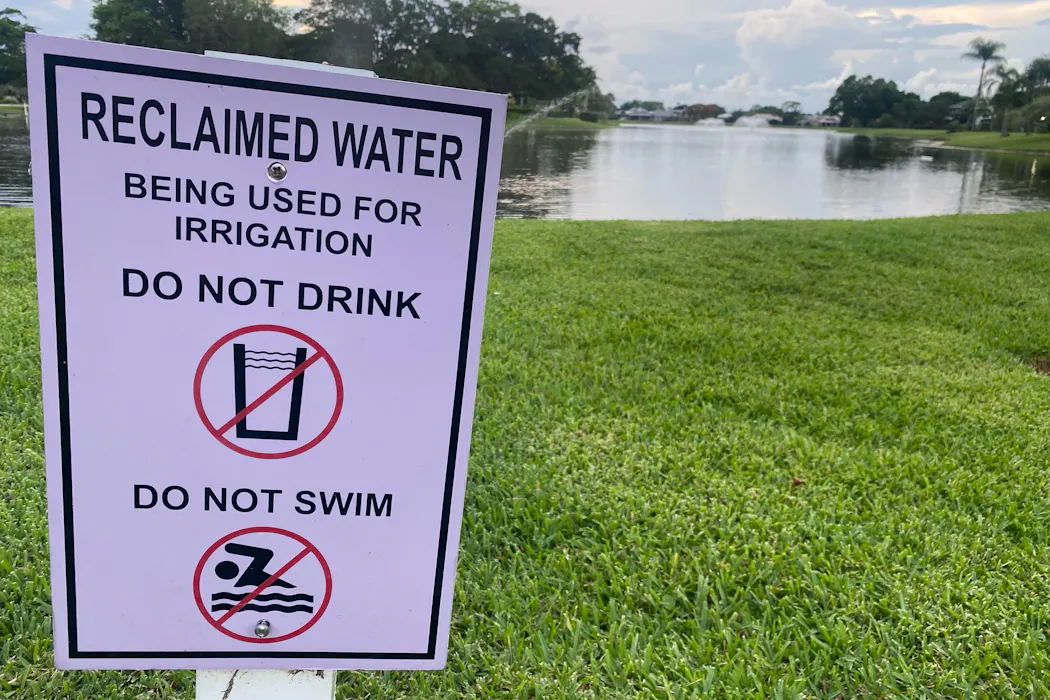
A sign warns passers-by that irrigation in the area uses treated sewage wastewater. Lindsey Nicholson/UCG/Universal Images Group via Getty Images

The nationwide cyclospora outbreak is very likely a result of sewage contamination in the food supply, according to scientific researchers and public health officials.

The parasite’s spread can become a self-perpetuating cycle. Cyclospora is found only in humans, where it replicates in the intestinal tract, causing severe diarrhea. The organism reproduces by releasing oocysts, which are excreted in those human feces. In the U.S., feces usually end up in sewage systems.

In many states, sewage water is treated – though not always in ways that remove or kill the oocysts – and then released into waterways and can be used to irrigate crops. The oocysts mature in the environment with warm temperatures in about a week. Then a human comes along and eats the irrigated food or drinks the water and gets sick, releasing more oocysts into sewage systems.

I am a public health water microbiologist who collects sewage water and tests it for evidence of harmful pathogens, such as cyclospora. The first time I studied cyclospora was in the first outbreak ever documented in the U.S., a small, 45-case outbreak in Florida in 1995.

The cause was initially suspected to be strawberries grown in California, but later it was determined it was more likely due to imported contaminated raspberries from Guatemala. That country’s raspberries were also associated with much larger outbreaks in 1996 and 1997. At the time, little was known about this single-celled protozoan pathogen.

More than 30 years later, the largest outbreak ever recorded in the U.S. has sickened more than 22,000 people, and contributed to the deaths of two in Michigan, where I live and work. Using treated sewage to irrigate crops is common in many places, especially where groundwater and surface water are in short supply.

What’s in wastewater

There are two reasons researchers like me collect sewage and monitor what’s in it.

The first is to evaluate levels of disease in a community. Measuring viruses such as SARS-CoV-2 in untreated sewage helped paint a picture of the spread of COVID-19 and the emergence of variants as the pandemic continued.

The second reason is to determine whether and how sewage treatment removes, inactivates or kills pathogens.

It is not easy to measure cyclospora oocysts in sewage, contaminated water or food. Even modern laboratory methods have trouble reliably detecting low levels of oocysts, which can still cause disease.

Cyclospora oocysts have been found in sewage around the world. A range of studies across the world shows that they can be detected in up to 25% of sewage samples – but not all studies report how high or low the concentrations of the oocysts were. So it can be hard to say exactly how widespread it is.

A person who is infected with cyclospora excretes somewhere between 100 and 10,000 oocysts per gram of feces for as long as 60 days. Based on what is known about other fecal pathogen excretions from patients, related to the concentrations of those pathogens in sewage, I estimate that there could be anywhere from 1 to 100 oocysts per liter in sewage.

Our laboratory at Michigan State University is developing a method to more accurately detect this parasite even at lower levels in sewage. This type of wastewater surveillance may help determine when an outbreak is beginning to subside and where larger numbers of people are still affected. In addition, this information could allow sewage treatment plant managers to regularly monitor their discharges.

A view through a microscope shows a small colored circle of a cyclospora oocyst.
A magnified view of a stool sample, seen through a microscope, reveals Cyclospora cayetanensis oocysts. Smith Collection/Gado/Getty Images

What happens during sewage treatment?

There isn’t clear data on how well standard sewage treatment processes reduce the numbers of cyclospora oocysts. But there is information on two other similar protozoa that also cause significant diarrhea in humans: Cryptosporidium produces an oocyst about half the size of cyclospora, and giardia produces a cyst that is similar in size to cyclospora.

From 2001 to 2003, my laboratory studied the occurrence of those protozoa at six sewage treatment plants – one each in Arizona and California and four in Florida. All had been approved by their respective state regulators for nonpotable reuse, including irrigation of landscapes and, in some cases, crops.

In that study, we found these protozoa in all the untreated sewage we tested, indicating there is some portion of the population that is infected and excreting their cysts or oocysts.

The five treatment plants whose processes included disinfection with chlorine were able to get rid of a high percentage – but not all – of the protozoa in their discharged wastewater. Some cysts and oocysts remained intact, with the potential to cause disease, even in water that had gone through the entire treatment process, as it is known that wastewater chlorination does not kill these protozoa.

From that data, it seems reasonable to assume that at least some small proportion of cyclospora oocysts also survive sewage treatment processes and are released back into the environment, where they can survive for months.

An aerial view of a field with sprinklers spraying water on the crops.
Crops are commonly irrigated with reclaimed sewage wastewater. David McNew/Getty Images

What about reuse?

Across the U.S., 200 billion gallons of treated sewage wastewater are used for irrigation of agricultural lands each year.

Some of that wastewater undergoes additional filtration and disinfection for reuse before being spread directly on landscapes or crops. The volumes, however, are not readily known. And other treated sewage, which undergoes only standard secondary treatment, is discharged into rivers, streams and reservoirs that could provide irrigation water.

But few states regulate efforts to remove or monitor protozoa such as cyclospora in treated sewage. Filtration can remove protozoa but must be designed and operated correctly. Chlorination is not effective, but ultraviolet light does inactivate cryptosporidium and eimeria, a chicken protozoan highly related to and used as a surrogate in studies testing methods of killing cyclospora by the food safety industry.

What is needed for better risk assessment and management?

As floods and droughts occur routinely across the U.S. and around the world, sewage may overflow into bodies of water or be used directly on crops. That increases the risk that diseases, including protozoa such as cyclospora, which are transmitted through ingestion of fecal matter, may spread through food and water supplies.

And because cyclospora oocysts mature in outdoor heat, it is possible that increasing temperatures, such as heat domes, could speed up their maturation, exposing more people to the infectious form of the parasite.

Modern technology and techniques are capable of monitoring water quality, detecting harmful pathogens and eliminating them. Expanding monitoring of wastewater for protozoan diseases and other dangers can help prevent outbreaks and slow the spread of disease from sewage-contaminated water in the future.

The Conversation

Joan Rose receives funding from Michigan Department of Human Health Services for Wastewater Surveillance. In the past she has been supported by the USEPA and the Water Research Foundation to evaluate microbes in wastwater and water. She is affiliated with International Water Association, Water Environment Federation and American Water Works Association. She is co-chair of the International Joint Commission's Health Professionals Advisory Board.

Read the whole story
hoz
17 days ago
reply
Share this story
Delete

Everything is Lonely

1 Share

🍕 I’m JA Westenberg. I write essays about technology, philosophy, productivity, and what it means to be human. If you like ideas that take their time, you’re in the right place.

While you’re here, a few things I’ve built: Kerouac, a writing app | Post Through It, a solo microblogging tool | Distributism.ai, my MCP platform | Laterware, all the AI news you need | Studio Self, a thought leadership agency for founders x VCs.

You can buy my book Permissionless here.


I don’t want to spend the next 5 minutes of your time hand-wringing like a NYT pundit.

I’m disinterested in passing judgment on my peers and the world around me for daring to commit the sin of scrolling through a phone; as far as I can tell, the tech influencers’ performative obsession with dumbphones has yet to save anyone from their isolation or rescue our social lives from their collective downward spiral.

But at the same time - we can’t pretend it’s not happening. Can we?

We can’t pretend that we’re as social now as we used to be; that we’re as connected to our neighbors, to our families, to our friends, as our parents and their parents. We’re tribes of one, increasingly cut off from each other and losing touch with ourselves, too.

It’s the modern paradox. If you can look past it, I envy you.

I find I can’t look away.

We’re hyper-connected, in the most shallow version of the word. We can - technically - reach out to any other human being, anywhere in the world and start a conversation. But we’re profoundly isolated - collecting lists of friends and contacts, while sending blue bubbles into the void.

I can give you stats, but you’ve already seen them.

I know you’ve already felt it.

We are a society that has been restructured for solitude, while being made less independent than ever, while our human biology keeps demanding community.

Something has to break.

Or perhaps, it’s already broken.

The End of the Third Place

When I was a kid, we moved around a lot.

We were an Air Force family, and my Dad was restless; whenever we put down roots, he tore them up again, and it was a new house in a new suburb, in a new state. Well, as soon as we settled in, I always did the same thing: I built a treehouse or a bolthole (or a make-believe TARDIS) where I could escape from Dad’s anger and rage and the noise of my world, and be alone.

It was my third space, and there was nothing unique about my urge to create one. We’ve always craved somewhere to go, somewhere to be, somewhere to belong, outside of our own four walls.

When more and more of us are living in rented dogboxes and working from home, variouisly broke and low on time, we need a “Clubhouse” more than ever.

But the third spaces are shrinking.

Cafes are still an option, but they’re running low on business, and they can’t absorb customers who take up space for an hour+ without spending enough to make their COGs worthwhile. And with the cost of living rising, how many folks can afford to buy 2+ coffees, a Danish and a cheese toastie just so they have somewhere else to exist?

We have fewer communal spaces now - and the ones we do have are losing funding and resources. Every suburb I visit now is trending toward commercialized, transactional environments. And I don’t believe for-profit businesses are a bad thing; I’m a part-owner of a bar and my mates run restaurants and cafes.

But a community needs something else.

You can’t build belonging around a bill.

We’re Individuals. That Didn’t Used to Be a Bad Thing.

…and it’s still not a bad thing.

Not really.

But it depends on your definition of the individual and your definition of independence.

We’re anti-dependent lately; we have a hyper-focus on the self.

Our New Self-Care insists we must avoid going out and having a couple of drinks as though it were a deeply sinful and taboo activity, that our spare moments must be spent at the gym, “training” - for what, it’s never clear - and avoiding anything that might constitute a vice.

TikTok’s would-be Freuds and unqualified therapy-speaking, totem-waving mystics keep telling us that we have to set boundaries; but the boundaries are selfish, and their adherents withdraw from their friends and loved ones over perceived slights and ambiguous and enigmatic “harms” that are ill-defined and ill met.

“I cut off my family. I cut off my sister. I left the group chat.”

We celebrate these things as acts of courage.

And perhaps they were!

But if you listen to the complaints of social media’s loudest sufferers, it’s hard not to suspect that if you’re that surrounded by that many toxic offenders, the one thing they have in common is you…

When it comes down to a personal choice, we’re picking loneliness. We don’t start families, we don’t date, we don’t settle down. Even “Settling Down” has mutated in its meaning; instead of seeing ourselves as courageous builders who create a settlement in the wilderness and build a home as a generational act, we hear the word “Settle” and assume its only interpretation must be “Settling” for less.

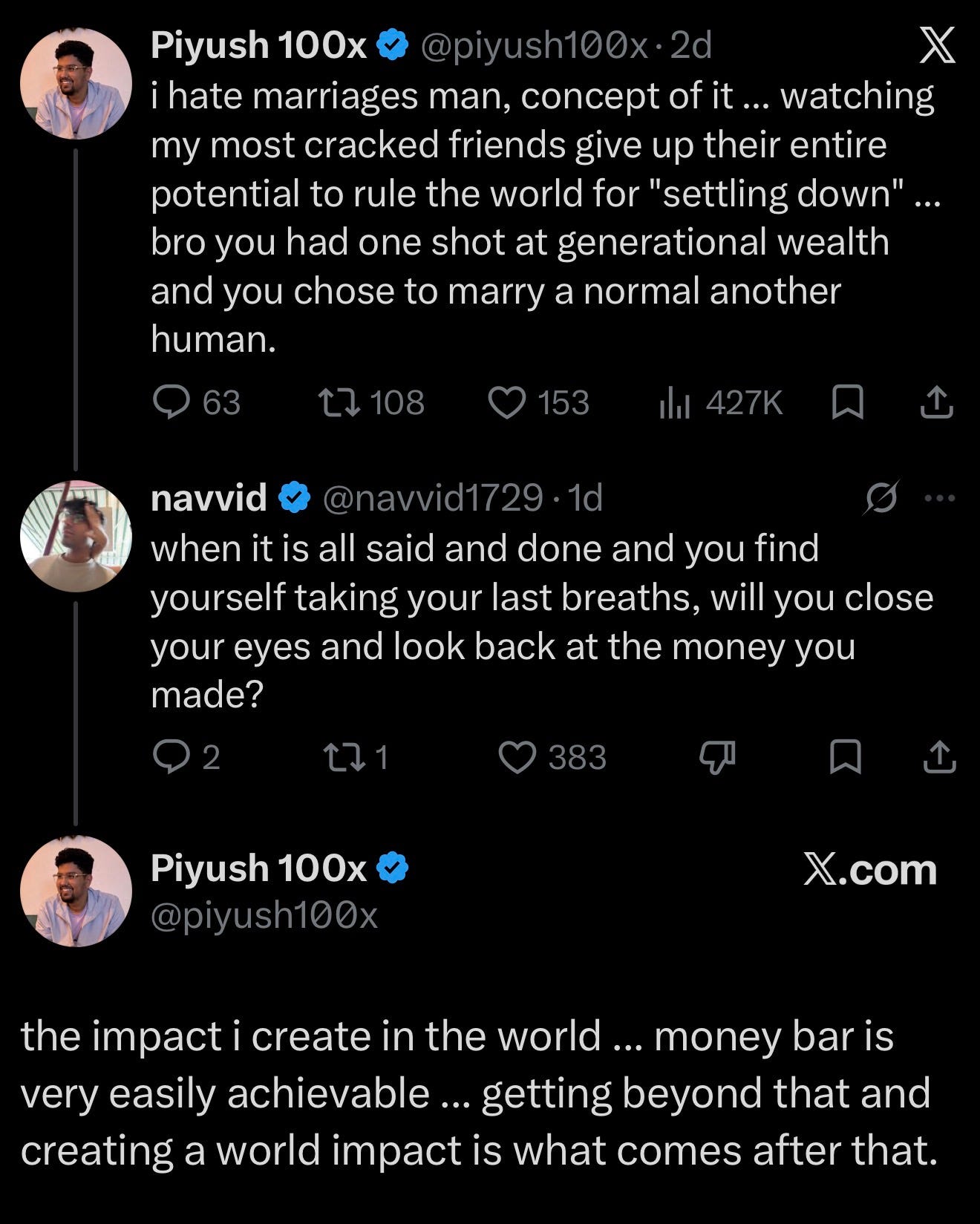
Builders and makers go viral on Twitter, decrying their mates who have given up their dreams and abandoned their potential if they have a kid, as though our biological purpose is to create the world’s 300th AI coding harness rather than reproduce.

We’re trending towards being alone.

And being alone doesn’t have to equate to loneliness.

But somehow, it does anyway.

Remote Working Isn’t Always a Good Thing

There are a million reasons why working from home is a gift.

But the more we lock ourselves away in our offices and endure Zoom calls and reply to torrents of Slack messages and emails, the less we actually interact with other human beings.

Remember those?

Remember how it felt to go out for a midday cup of coffee with someone you actually liked to break the monotony of your day? Remember casual workplace interactions where you had to actually apply your social skills in micro-moments of shared belonging?

Pepperidge Farm remembers.

Unless, of course, their workforce has gone remote too?

We’ve blurred our lines of demarcation. Home life has now become work life, creating bubbles of isolation, even from the people we actually live with. If you don’t pack up your bag and head home, if your work laptop is within arm’s reach, how present are you actually with your kid?

He wants to watch Avatar with you.

That’s a perfectly reasonable request.

But if you only watch it from the corner of your eye while you monitor a pointless Slack thread, you’ve failed to meet that request. You’re a hermit in your own home, cut off on your own couch from the people you nominally love.

The Illusion of the Feed

Social media is bad, blah blah blah.

You could almost copy and paste any other luddite-manifesto right here, and it’d make no difference. Why? Because we know it all already. There is nobody out there, nobody reading this, nobody scrolling past it, who genuinely believes social media is a Good Thing™️.

We’re not even in denial about it - we openly talk about how much the infinite scroll, the comparison compulsion, the outrage farming and the brain-rotting short-form videos are fucking with our mental health.

You can pitch it at any dinner party as an easy topic, and settle back to let a table full of people agree with each other that this thing sucks.

Doesn’t stop us, though, does it?

Even when we promise each other we’ll take a break, we’re right back an hour later, checking how many likes we’ve received on our brave posts about taking a break. I’d call it pathological, but the word has been coopted by the Instagram Amateur Psychologist Class.

The TL:DR is this. We’ve substituted the lowest-effort and lowest-denominator digital engagement and connection for anything approaching a deep, reciprocal relationship; and we’ve done it at scale and on the cheap.

The Single-Serve Entertainment Economy

On-demand streaming has increasingly slaughtered the time we used to spend on communal, water-cooler TV watching; and hyper-personal algorithms keep fencing us off from each other into isolated cultural experiences made Just For You.

In some families, the living room isn’t even multiplayer anymore.

You’ll have three generations, sharing the same space, in their own headsets and tablets and AirPods and binge-lists.

But it’s unnatural, and we crave something else. It’s why Christopher Nolan’s The Odyssey has dominated the internet for weeks; we desperately want something shared to fight and fawn over, something we can all hold, whether we hate it or not, that will make us feel like we have at least one thing in common.

Unfortunately, we’re a species drawn to convenience.

And algorithms are the pinnacle of convenience.

The Cost of the Anti-Social Century

Derek Thompson calls this the Anti-Social Century.

And that rings true as a diagnosis.

Americans are spending less time with other people than in any other period for which we have trustworthy data, going back to 1965. Between that year and the end of the 20th century, in-person socializing slowly declined. From 2003 to 2023, it plunged by more than 20 percent, according to the American Time Use Survey, an annual study conducted by the Bureau of Labor Statistics. Among unmarried men and people younger than 25, the decline was more than 35 percent. Alone time predictably spiked during the pandemic. But the trend had started long before most people had ever heard of a novel coronavirus and continued after the pandemic was declared over. According to Enghin Atalay, an economist at the Federal Reserve Bank of Philadelphia, Americans spent even more time alone in 2023 than they did in 2021. (He categorized a person as “alone,” as I will throughout this article, if they are “the only person in the room, even if they are on the phone” or in front of a computer.)

Chronic loneliness, depression and anxiety shouldn’t be the crises of our time. Surely, by now, we should be solving flying cars with Jetsons-level tech, not crying in the shower. But here we are.

We’re more anxious than ever.

We’re more fragile, too.

We’re sedentary and screen-obsessed, filtering our entire lives through glass rectangles on a yearly upgrade cycle. We’re more divided, more prone to living inside echo chambers, less likely to know the names of the folks who live one door over.

And we don’t trust each other.

In fact, we trust strangers on the internet more than the people we meet. Not that we “meet” them anymore; we don’t even make eye contact with strangers.

The Economics of Solitude

Living alone is a highly catered-to, optimized, and streamlined consumer category.

It’s no longer an economic impossibility, although it’s arguably more expensive than living in a unit. It might actually be the most monetizable human condition in history; it’s a condition of persistent pain and anxiety, and people in crisis are more likely to spend than people who aren’t.

We have single-serve meals and solo travel packages and now micro-living options built specifically for the family unit of one. And it’s easy to lay the blame for it on capital itself; but I don’t think there’s any grand plan here, enacted by some shadowy cabal to make us lonely and // or dependent. It’s simply capital pivoting to monetize the atomized individual, in the way that capital always adapts. The coordination failure and the profiteering happened at the same time.

A solo chef box is a relatively harmless product.

But we haven’t stopped there.

We’re in the early stages of AI companionship becoming normalized; virtual girlfriends (and much more rarely, boyfriends) and subscription-based parasocial relationships are getting normalized at an astonishing rate. The Pareto-optimal parts of our interactions and relationships (validation, comfort, belonging, the feeling of being known) are getting unbundled. And we’re making the high-variance friction of actual human relationships semi-optional.

The people who actually love you have their own needs; they get sick, they get sad, they get stressed out, and they might actually choose to abandon you. They have agency that isn’t necessarily used the same way as yours. But you don’t have to deal with that anymore! You can front a monthly fee and get a perfectly calibrated simulation of unconditional love and // or positive regard, whichever comes first.

And then of course - almost inevitably - you get the for-profit cleanup crew. You get the mental health and wellness industry offering remedial fixes for isolation. They have therapy apps and mindfulness retreats and affirmations and boundary after boundary, and now AI therapy too. Anything to slap a band-aid on the symptoms without addressing a single cause.

It’s an economy of rational agents, responding to rational consumer demand.

But it’s also a perfectly closed economic loop.

We created the ideal conditions for atomization, and then we sold ourselves a synthetic patch for the resulting void, and now we’re selling ourselves the emotional suppressants and painkillers to cope with the fact that the patch isn’t real.

The Urban Design of Isolation

If the first level of isolation is economic and the second digital, the third is spatial.

We’re building cities optimized for a Nash equilibrium of privacy. Every individual is either consciously or subconsciously minimizing their exposure to strangers and chance encounters; micro-apartments and co-living spaces are nominally designed to be millennial-friendly communes, but in practice they’re little more than hyper-efficient storage units for isolated individuals who sleep and work in safely demarcated boxes.

The aggregate result is a worsening social desert.

Meanwhile, those who can afford to are retreating from the shared world into gated communities with private amenities. The ideal is to pay a premium to ensure they never have to share a swimming pool with the public at large. Even the neutral spaces left behind are engineered against human lingering; our architecture is hostile, divided, and unergonomic; park benches ward off couples and families as much as the homeless; and unstructured public squares have functionally ceased to exist.

Our zoning laws - and of course, there are more and more of them every year - divide human existence into separate quarters and isolated pods for living, working, playing, and praying. You have to drive from one to another, sealed in a metal box, never actually interfacing with the ambient organism of a city full of living, breathing people.

Reclaiming Our Social Nature

If the gravity of everything we’re building and buying is pulling us toward isolation, how do we reclaim a social nature?

It takes a philosophical reframing of the entire concept of “social friction.” For the last fifty years, absolute convenience has been the supreme god of consumer culture, but it’s the enemy of human contact, friendship, and familial love. IE, if you actually optimize your life so you never have to go to the store, and you certainly never have to wait in line, you never have to talk to a cashier, ask a stranger for directions, or maintain the simple skill of small talk.

And yes, small talk is a wonderful thing. It’s the subtle glue that bonds us, far more than spouting off about whether or not we’re living in a simulation, or whether God or Elvis are dead. It’s talking about the weather, how much it sucks, and how much the crops need the rain, etc.

There are choices you can make - choices I can make. To go pick up Pad Thai in person instead of getting it delivered to your door via an app. To refuse to outsource every minor chore to a slab of glass and a service-economy. And yes, to wile away a few minutes of your time in low-information and occasionally cringe and embarrassing ritual of “chit chat.”

Believe me, it won’t kill you.

You need to have the tolerance to survive the initial awkwardness it takes to build a relationship worth a damn.

It’s Not Kids These Days

I don’t want to get to the end of a screed and be dismissed as though I have a problem with “kids these days,” etc. Of course, it’s not; it’s older generations retreating into Facebook, as much as Gen Z withdrawing into TikTok. It’s everyone. It’s probably you; and it’s definitely me, I’m willing to admit it.

If everything is loneliness, it’s a measurable and impending health crisis, with a mortality risk roughly the same as smoking fifteen cigarettes a day; and if we don’t stage an intervention for ourselves, we’re looking at a decade, and then another, and then a century of decaying cohesion, dying trust, and human thriving becoming near-obsolete.

Humans are biologically built for community.

Our operating systems might be hyper-individualistic now, but they’re still running on paleolithic hardware, and the problem isn’t with the hardware. Wanting to be around folks you actually give a shit about isn’t unnatural, and it’s not a weakness. It’s fundamentally what makes us human.

We’ve given up a lot. But we haven’t given away the whole game. Not yet. And until we’re all so many red-jump-suit-wearing Wall-E-ignoring space travelers, I think we still have a chance to reclaim the cringeworthy, meat-based relationships that actually built our civilization in the first place.

I certainly hope we do.

I’ll leave you with that; I’m walking down to the local bookstore and getting a black coffee. Wish me luck.

Read the whole story
hoz
25 days ago
reply
Share this story
Delete

Gerth: My too-early 'tribute' to Mitch McConnell | Opinion

1 Share

Updated July 22, 2026, 9:54 a.m. ET

  • The columnist shares a pre-obituary for Sen. Mitch McConnell, written while the politician is still alive.
  • It argues McConnell's legacy will be defined by his manipulation of the Supreme Court and his support for Donald Trump.
  • McConnell's actions with his past support for civil rights are contrasted with his failure to hold Trump accountable.

Following the unexpected death of U.S. Sen. Lindsey Graham on July 11, it seemed that any criticism of the South Carolinian online garnered the same response — “How dare you say that about a guy who just died?”

It didn’t seem like it mattered if the criticism was legitimate or not, whether it was questioning his sexuality while voting against gay and lesbian rights issues, or whether it was his flip-flopping on Donald Trump and becoming one of his biggest supporters.

The reaction from Republicans was largely the same.

That got me thinking about Sen. Mitch McConnell, who was rumored to be dead or on life support or in a coma or whatever and was the odds-on favorite to beat Graham to the gates of hell in the days before Graham’s death.

And, so with McConnell allegedly on the mend, I figured I’d go ahead and tell you what I think about McConnell now — when no one can complain, “How dare you write that about a dead guy?”

Let me be straight up now, newspaper staff-written obituaries are not intended to eulogize or lionize the dead. They are intended to tell the truth about the recently departed — or the not yet departed, in this case.

Warts and all.

If you want a glowing remembrance of a politician, read the obituary that the family writes and pays to put in the newspaper or runs online.

And so, what to say about Mitch?

I wish the late Louisvillian, Hunter S. Thompson, were still around to tell the story of McConnell, the former Senate majority leader when he passes from the scene.

Thompson’s obituary upon the death of Richard Nixon was a master class in truth-telling. It painted Nixon as the detestable person he was, who nearly broke the government with his lies and his efforts to hold onto power at any cost.

A detestable figure

U.S. Sen. Mitch McConnell and wife Elaine Chao in a hospital room.

And McConnell is every bit the detestable figure that Nixon was.

But unlike Nixon, McConnell never paid for his sins that have damaged our nation’s trust in government, destroyed the country’s ability to have meaningful dialogue and cemented our nation’s politics as an arena in which winning is the only thing that matters.

In fact, for all of Nixon’s flaws and crimes, he proved that the system worked as he was held accountable for what he had done. It took real leadership to do that though — Republican Sens. Barry Goldwater and Hugh Scott and Rep. John Rhodes essentially forced him to resign.

The fall of Nixon was a triumph for our country.

It’s hard to imagine McConnell ever having the guts or the desire to protect the nation like Goldwater, Scott and Rhodes did that day in 1974 when they went to the White House and told Nixon it was over.

This isn’t to say that everything McConnell did was bad.

Not all bad

He stood forcefully for the ability to burn flags as a distasteful but protected exercise in free speech, and he brought money back to Kentucky much like the late Senate Democrat Robert Byrd did in West Virginia.

He claimed $38 million in unappropriated dollars to help build the Parklands in Louisville two decades ago and was instrumental in getting the money needed to build a companion to the Brent Spence Bridge between Covington and Cincinnati.

He was the leading force in pushing for a tobacco buyout that sent billions of dollars to Kentucky and protected the state’s farmers when the tobacco industry price supports went away.

As Jefferson County judge-executive, he nearly doubled the size of the Jefferson Memorial Forest, making it one of the largest urban forests in the United States. He fought for auto emissions testing to help clear the smog from Louisville’s air, and he was lauded nationally for his work on exploited and missing children.

And he rebuilt the Republican Party in Kentucky taking it from a party that had just a fraction of the number of voters as the Democrats to a dominant party in the state over the 42 years he was in office.

In the process, he became the longest-serving senator in Kentucky’s history with 42 years in office and Senate’s longest serving party leader with 18 years leading the Republican conference.

His true legacy

But none of that will matter.  

Sure, he’ll be a footnote in history for the fact that he was the longest-serving leader — but no one is going to remember any of those other things.

What he’ll be remembered for is two things that have done lasting damage to the country and its politics.

First is his cynical and hypocritical manipulation of the U.S. Supreme Court confirmation process that over a four-year period shifted the court from a center-right body to a far-right body that overturned 60 years of case law on civil rights and nearly a century of law that empowered Congress to check a president’s power.

The man who once boasted that he split with his party in 1964 and voted for Lyndon Johnson because of Goldwater’s opposition to civil rights was the key player in dismantling those rights he stood for as a young man.

He had more guts as a young man than he had as an old man.

It seems somehow fitting for the ultimate shape-shifter, who wrote about accompanying Sen. John Sherman Cooper to see Johnson sign the Voting Rights Act into law, that the court he created was the court that struck down the last remaining significant provision.

“I was overwhelmed to witness such a moment in history, knowing that majorities in both parties voted for the bill,” McConnell wrote in his memoir, “The Long Game.”

As the court he built chipped away at the Voting Rights Act, McConnell cheered.

And it’s not just that he built this court — it’s the hypocritical way he did it.

McConnell blocked Barack Obama’s appointment of Merrick Garland to replace Antonin Scalia on the court in 2016, saying the American people should decide at the polls who got to make an appointment in the last year of an administration.

And then after Ruth Bader Ginsberg died in 2020, McConnell forced through the confirmation of Amy Coney Barrett just eight days before Trump lost his reelection.

McConnell’s shenanigans turned what had been a 5-4 conservative majority with one member being a reliable swing vote — into a solid 6-3 radical conservative court.

In the process, McConnell destroyed the court’s credibility with the American people.

A court that's not trusted

In July of 2020, two months before Ginsberg died, the court’s approval rating stood at 58%, according to Gallup. The latest Economist/YouGov poll found just 36% of Americans approve of the job the court is doing.

And a Washington Post/IPSOS poll released July 18 found that nearly half of Americans believe the justices are making decisions based upon political ideology and not the rule of law.

This is the America that McConnell has created.

But his biggest failing may be his embrace of a president who he believes is stupid and who he believes led an attempt to overthrow the United States’ government on Jan. 6, 2021.

All to protect and increase his own political power.

In the year after the attack on the Capitol, McConnell called it what it was.

"It was a violent insurrection for the purpose of trying to prevent the peaceful transfer of power after a legitimately certified election from one administration to the next,” he said in 2022.

And, in the days following the attack, he said that Trump was “practically and morally responsible” for the insurrection.

But he refused to vote to convict Trump on impeachment charges.

A 'stupid,' 'ill-tempered' president

According to the book, “The Price of Power,” by Michael Tackett, the deputy Washington Bureau chief of the Associated Press,” in interviews and recorded diaries, McConnell called Trump “stupid as well as being ill-tempered,” a “despicable human being” and a “narcissist.”

Despite all this, when Trump ran for president in 2024, McConnell continued to support him.

Even when Trump said racist things about McConnell’s wife, former Transportation Secretary Elaine Chao, McConnell continued to bend his knee.

And that is the legacy of Mitch McConnell.

He ends his career adopting the anti-civil rights positions Barry Goldwater supported, handed to him by a despised and distrusted Supreme Court that he created, but didn’t have an iota of the bravery Goldwater summoned to stand against a criminal and corrupt president.

Whew! I’m glad I got that off my chest while he’s still alive.

Joseph Gerth can be reached at 502-582-4702 or by email at <a href="mailto:jgerth@courierjournal.com">jgerth@courierjournal.com</a>. You can also follow him at @jgerth.bsky.social.

Read the whole story
hoz
35 days ago
reply
Share this story
Delete

Study Hacks - Decoding Patterns of Success - Cal Newport

1 Share

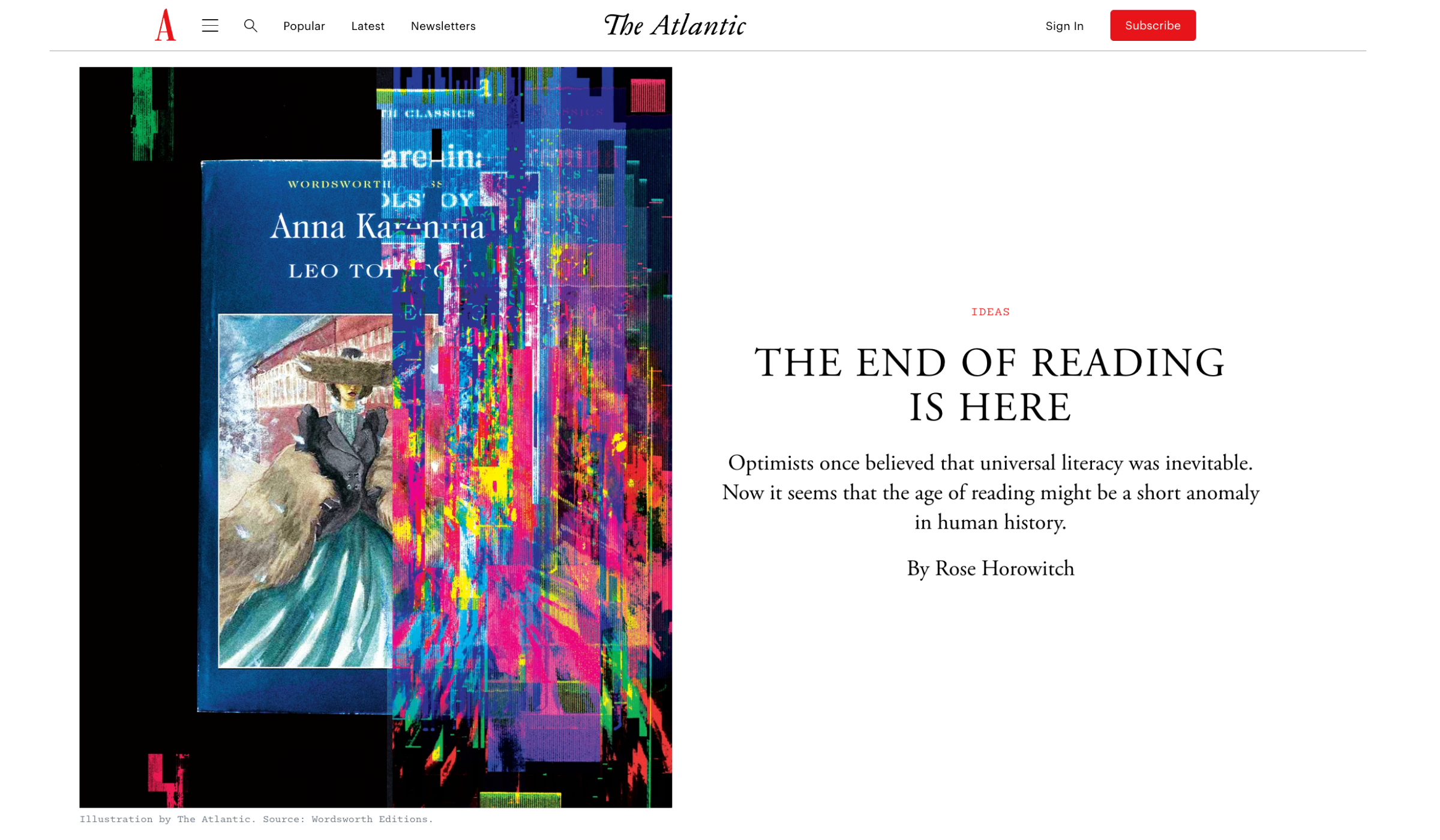
Last week, Rose Horowitch published a splashy Atlantic article titled ​“The End of Reading is Here.”​ (Ironically, given the subject matter, it weighed in at over 8,500 words.)

Horowitch’s argument, which elaborates on similar concerns recently raised by commentators ​such as James Marriott​, is that distracting digital technology has led to a sudden and radical reduction in reading.

Here are just some of the data she cites to back up this claim:

  • Less than half of all adults reported having read a book of any kind in 2022. Only 38% read a novel or short story.
  • The proportion of American adults who read for pleasure on any given day has fallen from 28% in 2004 to 16% in 2023, while the proportion who read to a child is down to 2%.
  • Over 60% of high school seniors struggle, to varying degrees, with interpreting text.
  • Nearly 30% of American adults cannot paraphrase a multipage text (representing a 50% increase from a decade ago).
  • Between 1984 and today, the proportion of 13-year-olds who said they “rarely or never” read for fun rose from 8% to 29%.
  • (To be sure, book sales have been holding steady in recent years, but as Horowitch notes, this potentially obscures a shift in which a small percentage of serious readers are consuming more books, compensating for an overall drop in people who read regularly.)
  • And so on…

The key question is whether these reductions matter, or if they just represent a normal evolution of communication technology, similar to how fewer people listen to the radio than they did a century ago.

Read more

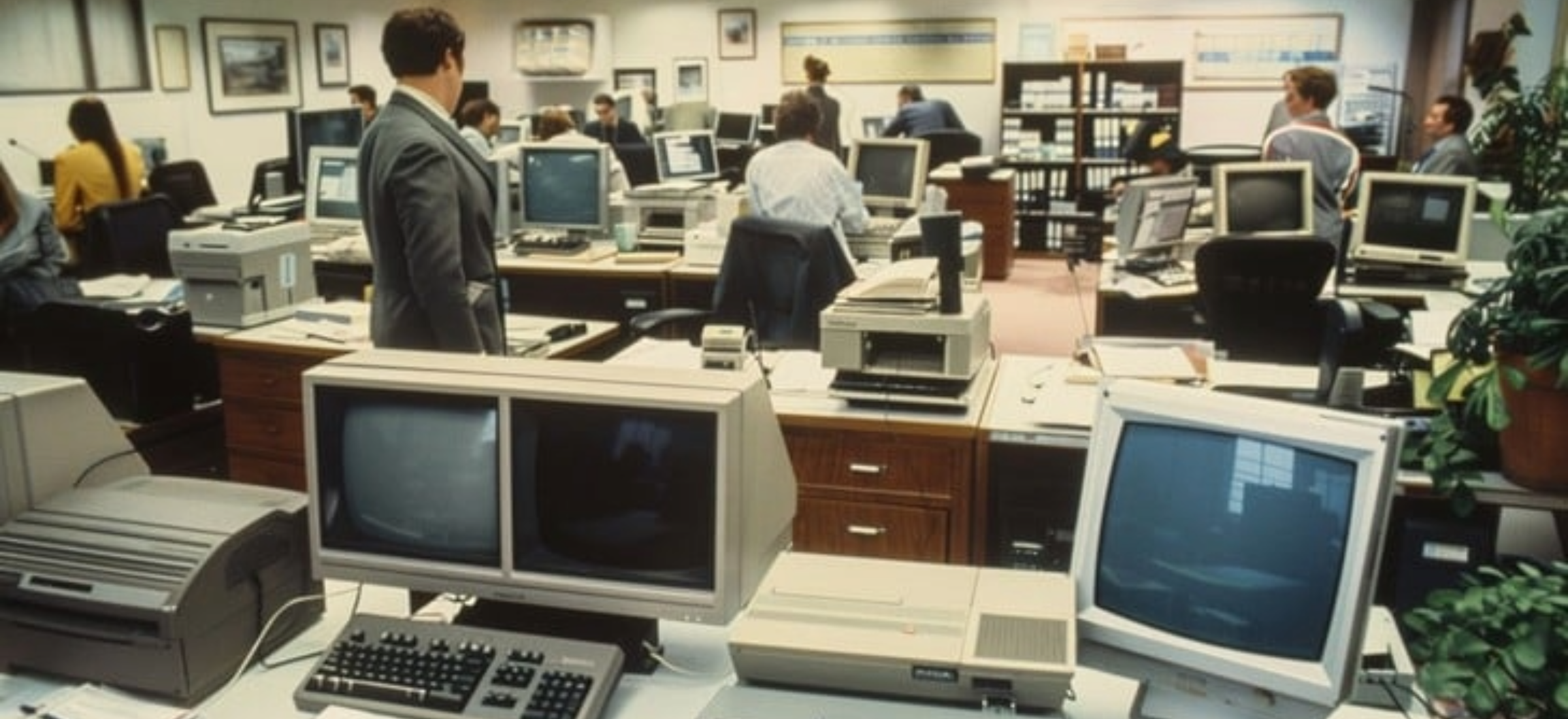
Few recent technological innovations were better poised to become a productivity slam dunk than the personal computer. Spreadsheets, word processors, databases, presentation software, email – the list of programs that could vastly simplify common tasks seemed endless.

As I reported in ​a 2021 op-ed for WIRED, however, reality proved more complicated. For example:

  • A 1991 article in the New York Times quoted an economist who said that despite heavy spending on computers, “white-collar productivity has stagnated.” He concluded: “No longer are chief executives confident that throwing computers at their office staffs will result in greater efficiency.”
  • A study covering the period from 1987 to 1993 calculated that computers added only 0.2 percentage points a year to business output growth, leading a contemporaneous summary to declare that the “impact of computers on recent productivity growth has been vastly overstated.”
  • In his 1997 book, Why Things Bite Back, Edward Tenner argued that these findings underscored what he called a “productivity paradox.”

I thought about this article recently as I continue grappling with our current AI moment. It’s natural to assume that this technology, which clearly makes certain common professional activities easier, will make our working lives more productive overall.

But as the early years of desktop computing taught us: it’s not always so simple.

Read more

Imagine, for a moment, the following scenario. The Ford Motor Company releases a slick whitepaper making the alarming claim that they’re concerned their popular F-150 … Read more

The Financial Times ​recently reported​ an interview with Rebecca Hinds, head of the Work AI Institute. Hinds was discussing a new survey of 6,000 digital workers, which included the following arresting statistic: although respondents claimed that AI saved them 11 hours a week on average, only 13% reported any improvement in company performance.

Hinds offers three explanations for this paradoxical result:

Read more

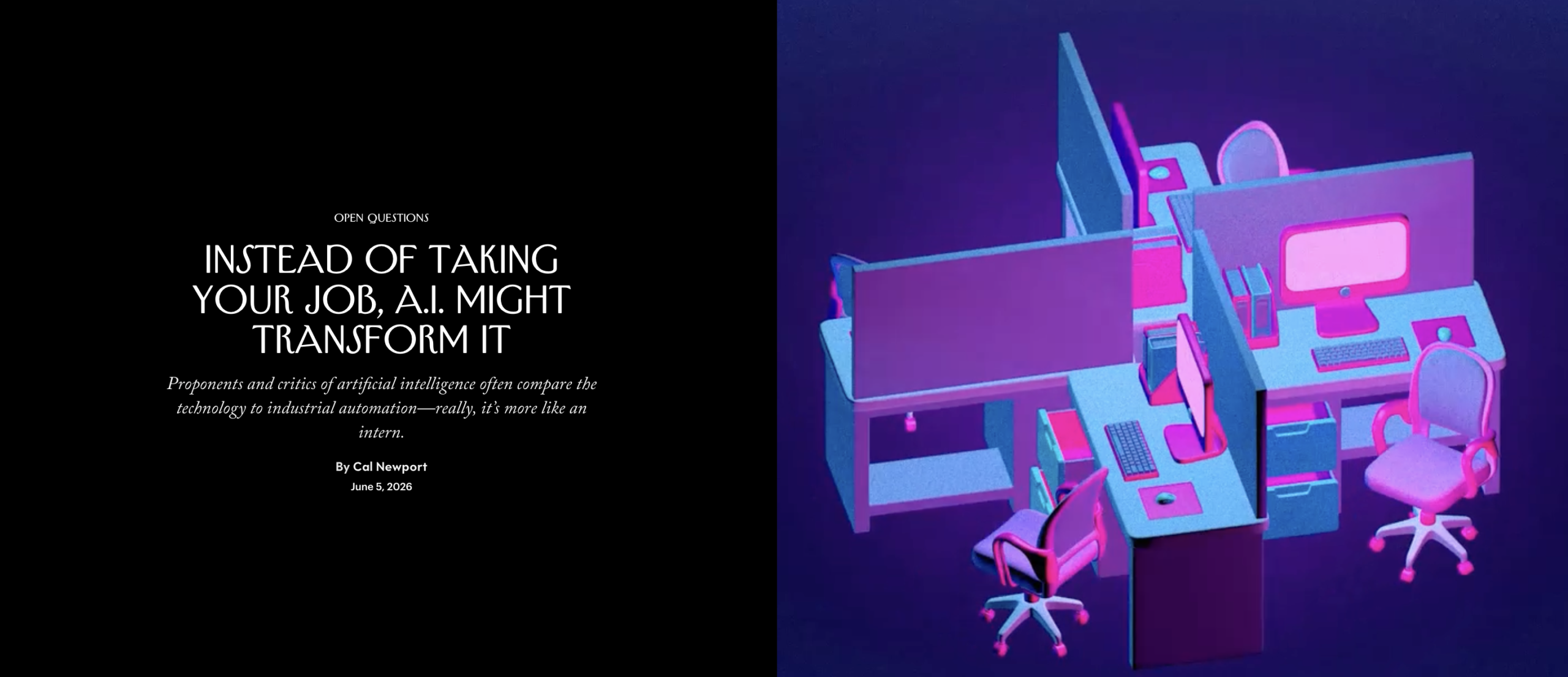
The leaders of AI companies often compare their technology to industrial automation: just as machines eliminated jobs that depended on human brawn, AI will eliminate jobs that rely on brains. Anthropic CEO Dario Amodei has suggested on multiple occasions that his AI-based tools will ​automate half​ of entry-level white-collar jobs. Not to be outdone, Mustafa Suleyman, the CEO of Microsoft AI, ​predicted ​in February that AI will deliver “human-level performance on most if not all professional tasks” within the next twelve to eighteen months.

As I​ recently discussed​ on an AI Reality Check episode of my podcast, however, some of these same leaders have started pulling back from automation discourse.

Two weeks ago, while appearing at a conference in Australia, ​Sam Altman said​ that he was “delighted” to be wrong about AI creating a “jobs apocalypse.” And Amodei is ​now saying​ that AI won’t replace jobs but will instead replace large parts of existing jobs, changing what employees do in their roles.

If automation is the wrong analogy, what could be better? In my most recent article for The New Yorker, which is titled ​“Instead of Taking Your Job, A.I. Might Transform It”​, I investigated possible answers.

Read more

Last fall, the Notre Dame philosopher, Meghan Sullivan, participated in a closed-door meeting at the Vatican. She was there to discuss AI ethics with a group of religious thinkers, academics, and leading members of the technology industry.

As Sullivan recalls in ​a recent newsletter​, she attended an optional Catholic Mass the first morning, held in an ancient church. She was surprised to see one of the tech leaders sitting a few rows away in the pews. “[This was] the kind of guy you typically see in a black t-shirt and chinos,” she writes. “That morning he was dressed in a brown suit and tie, quietly taking in the sanctuary as the first rays of morning light filled the room.”

After the service concluded, they chatted. The tech leader, it turned out, was not Catholic. When Sullivan asked him why he was here, he gave the following answer:

“We’re building something that is going to change life as we know it. I want to make sure I keep in touch with what humans have always cared about. This is a place that takes care of those values.”

I found this interaction chilling. Not because of what it says about potential AI disruptions, but because of what it tells us about the engineers developing this technology.

Read more

The second chapter of Genesis poetically describes the beginning of the human story. “The Lord formed Adam from the dust of the earth,” it reads. … Read more

If you’ve been following technology news recently, you’ve probably noticed a sudden increase in references to a 19th-century economics theory called the ​Jevons Paradox​, which is named for the neoclassical economist William Stanley Jevons, and captures the observation that increasing the efficiency of a resource can lead to greater consumption.

Jevons first articulated this idea in an 1865 book, pithily titled, The Coal Question: An Inquiry Concerning the Progress of the Nation, and the Probable Exhaustion of Our Coal-Mines. He argued that building more efficient steam engines – ones that required less fuel to generate the same power – would not solve the problem of England’s diminishing coal supplies. If you made the engines more efficient, Jevons predicted, people would find more applications for steam power, and even more coal would be burned overall.

Read more

Read the whole story
hoz
40 days ago
reply
Share this story
Delete
Next Page of Stories